
Care Home Medication Management: Records and Audit
SilverGuard Technologies Limited8 min read
Care home medication management in Hong Kong is a record and custody system. Staff with relevant training prepare and give medicines under the Code of Practice for Residential Care Homes (Elderly Persons); every dose is checked against the Medication Administration Record and signed immediately, and medicines are kept in a locked, labelled place.
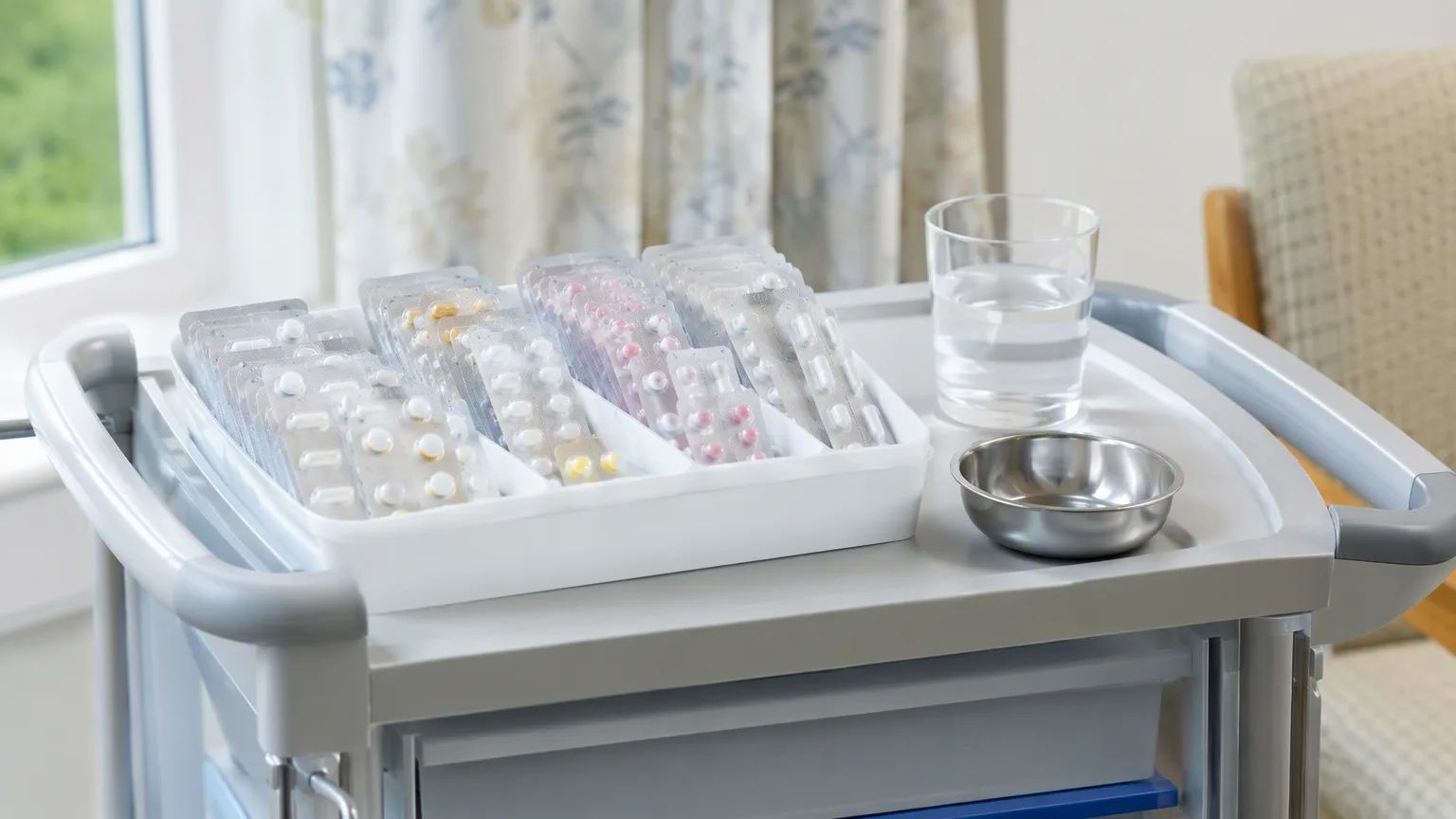
Medication management is a record system before it is a clinical one
A medication round looks like a clinical task and is mostly a custody and record-keeping task. Someone receives a prescription, holds the medicine, checks it against a record, gives it to the right resident, and writes down what happened. Most of the failures that reach a review are failures in one of those steps, not a disagreement about which medicine was chosen.
That is why the requirements a Hong Kong residential care home works to are mostly about who may handle medicines, where they are kept, and what is written down. The Social Welfare Department's Code of Practice for Residential Care Homes (Elderly Persons) sets those requirements out in paragraph 12.6, and the Guide on Drug Management in Residential Care Homes 2018, published jointly by the Social Welfare Department, the Department of Health and the Hospital Authority, describes the procedures step by step.
Nothing here says which medicine to give, how much, or when to stop one. Those decisions belong to the prescriber and to the pharmacist. What follows is the system around them: the roles, the storage, the two records, and the trail an inspector follows.
Who may prepare medicines and who may give them
The Code of Practice does not leave this to local custom. A home should arrange for staff with relevant training, nurses or health workers, to prepare drugs, and the same trained group gives drugs and assists residents in taking them [Code of Practice 12.6.7(a) and 12.6.8(a)]. The home manager has to ensure that everyone designated to handle drugs has received proper training, as part of induction and of regular training [12.6.2]. The footnote to that grade excludes a self-care hostel as stated on its licence [12.6.7(a), footnote], which is a reminder to read the licence before assuming a staffing model.
- The home manager owns the system: the procedures, the training record, and the response when something goes wrong.
- The nurse or health worker prepares and gives, and signs for both.
- The prescriber decides what is prescribed. A home may not change a dose or a route on its own initiative, and seeks medical advice when in doubt [12.6.3].
- A home may not re-distribute one resident's medicines to another resident [12.6.4].
- The pharmacist, including the community pharmacy that packs doses, supplies and advises. Reviewing a resident's medicines is a professional function, not a home decision.
The two records that carry the audit trail: the IDR and the MAR
Two documents do most of the work. The Individual Drug Record (IDR) holds the history for one resident. The Medication Administration Record (MAR) holds what is being given day to day. The Code of Practice states what each must contain.
Around both records sits a checking routine the Code of Practice requires: three checks and five rights. A check when the medicine comes out of the cabinet, a second before it leaves its packet or bottle, and a third before it goes back into the cabinet. The five rights are the resident, the drug name and dosage form, the dosage, the frequency and time, and the route [12.6.7(a)]. The five rights are applied a second time at the point of giving [12.6.8(b)]. The routine exists so that the record and the medicine agree at three separate moments. A home whose staff sign the whole round at the end of the corridor has already broken it, and the break stays invisible until the day the count does not match.
- The Individual Drug Record: resident particulars, drug allergy history, drug names, dosage forms, dosages, frequency and times, routes, the dates each drug started and stopped, where each drug came from, precautions, and the signature of the staff member who made each entry [12.6.9(b)].
- The Medication Administration Record: resident particulars, allergy history, the drugs in current use with their prescription dates and sources, dosage forms, dosages, frequency, times and routes, and the signature of the staff member who prepared and of the one who gave [12.6.9(c)].
- When a prescription changes, both records are updated the same day [12.6.9(d)].
- The person who prepares signs immediately after preparing, and the person who gives signs immediately after giving. Signing in advance, or on someone else's behalf, is prohibited [12.6.7(b) and 12.6.8(d)].
- Where a resident does not take a medicine, the reason is written against that dose rather than left blank [12.6.8(d)].
Storage: locked, labelled, separated and per resident
Storage is where the regulation speaks most plainly. Under section 33(1) of the Residential Care Homes (Elderly Persons) Regulation, all medicine kept in a home must be kept in a secure and locked place to the satisfaction of the Director of Social Welfare [12.6.6].
The Guide lists the equipment that makes this workable: a drug cabinet, individual drug storage compartments, labels, drug packets or bottles, and a refrigerator for the items that need one [Guide, Chapter 2.3]. A home that keeps its refrigerator unlabelled and its compartments unnamed has a system that only works while the same two people are on shift.
Two exceptions need paperwork. A resident who self-stores and self-administers medicines needs a written assessment and consent, reassessed at least once every six months [12.6.11(b)]. Chinese medicines are recorded on the same two records as everything else, with the prescription number noted so the prescription can be verified [12.6.10].
- Every drug, whether oral, topical or injectable, is clearly labelled and held in a secure place such as a locked drug cabinet or a locked room, under the monitoring of designated staff.
- Each resident's medicines are stored in their own compartment bearing the resident's name, and one compartment holds one resident's medicines.
- Oral, topical and injectable medicines are stored separately from each other.
- Storage follows the directions on the label, including temperature and protection from direct light.
Preparing, giving, and the 24-hour limit
There is a limit on how far ahead a home may work. Unless a designated drug preparation system is in use, drugs may be prepared no more than 24 hours in advance [12.6.7(c)]. A designated drug preparation system means a multi-day preparation system, a preparation service provided by a community pharmacy, or an automated packaging system [12.6.7, footnote]. Where an automated packaging system is used, the home follows the Guide's requirements for it [12.6.4].
At the point of giving, the staff member stays until the medicine has been swallowed [12.6.8(c)], and identifies residents with communication difficulties or cognitive impairment by name, bed number or photograph so that the right person takes the right dose [12.6.8(e)].
The 24-hour limit is the rule most often lost in a busy home, and it is the one that produces the largest gap between the record and the cabinet. If the round is prepared the evening before, the cabinet count the next afternoon will not match the record, and an inspector can see which of the two moved.
Paper record, electronic record, or pharmacy-packed doses
The three ways of running the same round fail in different places. The Code of Practice allows all three, and requires an electronic drug management system to follow the Guide's principles on work procedures, operating guidelines, monitoring mechanisms, protection of personal data, contingencies, and the requirements of an electronic signature [12.6.5].
| Approach | Who prepares | Who checks | What is recorded | Main failure mode |
|---|---|---|---|---|
| Paper cabinet and handwritten records | A nurse or health worker prepares from the locked cabinet | The same staff member applies the three checks and the five rights, then applies the five rights again at the bedside | The Individual Drug Record and the Medication Administration Record, signed at preparation and again at giving | Entries completed after the round, signatures added in advance, and a record nobody can search when a pattern is suspected |
| Electronic drug management system | A nurse or health worker prepares as before | The system prompts the checks and holds the electronic signature | Time-stamped entries that a report can read rather than a page a person must decipher | Downtime with no paper fallback, records that drift from the printed prescription, and resident data spread across more devices than the home can account for |
| Pharmacy-packed or automated dose supply | The community pharmacy or an automated packaging system prepares the named doses | The home still checks at the cabinet and again at the bedside | The pack label identifies resident, drug, dose and time, and the home's record still carries the signature | A prescription change that has not reached the next pack, and packs that are hard to identify under time pressure |
The electronic option is the one managers ask about most, usually because they expect it to remove the paperwork. It does not. It moves the signature from a page to a screen and makes the trail searchable, which is a real gain when a home has to answer whether a pattern exists. It also adds a dependency: if the system is unavailable the round still has to happen, and the fallback has to be written before it is needed rather than invented at 8am.
Pharmacy packing moves the preparation risk upstream and leaves the checking and the record with the home. Either way the responsibility stays with the home. Nothing in the Code of Practice transfers accountability to a supplier.
When a dose is missed, refused, wrong or expired
These are the events the record exists to capture, and the Code of Practice treats a group of them as drug incidents: anything abnormal in the administration of drugs, including a resident not following the prescription, one resident taking another resident's medicine, a wrong dosage, or expired medicine in use [12.6.12]. A serious drug incident that results in a resident being hospitalised triggers a written route: a Special Incident Report and a Medication Risk Management Report to the Licensing Office of Residential Care Homes for the Elderly within three calendar days, public holidays included [12.6.12].
Whether a missed dose should be made up, whether a reaction needs review, and how treatment continues are decisions for the prescriber or the pharmacist. The home's procedure should name how that contact is made at night as well as during the day, because a decision that cannot be reached at 2am is not a procedure. The Guide covers refusal of medication, omission, suspected allergy and incident follow-up in its fourth chapter [Guide, Chapter 4].
One storage item has a legal home of its own. Expired and surplus medicines are chemical waste, handled under the Waste Disposal Ordinance (Cap. 354) and the Waste Disposal (Chemical Waste) Regulation [12.6.14]. A cupboard of out-of-date medicines is not only a medication risk. It is a waste-disposal obligation a home may not have noticed it has.
- What was given, to whom, and when, written against the dose at the time.
- What the resident was observed to do, described rather than diagnosed.
- Who was told and when, including the prescriber, the family, and the licensing office where the incident is serious.
- What was changed afterwards so the same step is not repeated.
What an inspection opens first
An inspection is not a surprise about which documents matter, because the Code of Practice lists them. The home manager has to keep a comprehensive, regularly updated record system in the home for inspection at any time, covering residents, accidents, deaths and discharges, personal health and nursing records, restraint records, admission agreements, possessions, complaints, visits by medical practitioners, the log book and staff records [8.7.2]. The medication records sit inside that system: the Individual Drug Record, the Medication Administration Record, consent forms for self-administration, and the confirmation form used when a resident takes proprietary or non-prescription medicines [Annexes 12.2 and 12.3].
The Social Welfare Department's written answer to a Legislative Council question on medication management notes that the department also advises homes on how their drug management should be improved during inspections. That is worth remembering: an inspection is also the point at which a home is told what to fix.
- The Medication Administration Record against the drugs actually in the cabinet, item by item.
- The label on each pack against the resident whose compartment it sits in.
- The signature on each dose against the shift record for that hour.
- The last update date against the date of the last prescription change.
- The date a drug incident report was sent against the three-day deadline, where one applied.
A self-check you can run on a Tuesday afternoon
Pick five residents at random and answer six questions about each, honestly, from the records as they stand.
The exercise is not a score. It is the same six answers a licensing officer will assemble, arriving earlier and without an audience. A home that keeps its record current does not need to prepare a story for it, and the staff who keep it current are the ones who benefit when a family asks what happened on a particular night.
- Does every dose given this week carry a signature, in the right place, at the right time?
- Is every pack in the cabinet labelled with the name of the resident whose compartment it is in?
- Was every prescription change this month reflected in both records on the same day?
- Is there a written reason beside every dose that was refused or not taken?
- Is the cabinet locked, and is the key held by a designated person, at this moment?
- If there was a drug incident, was the report filed, and is the follow-up written down?
Explore more
- SilverGuard Insights on care homes : our other writing on running a home, from falls to documentation.
- Preparing for a care home inspection : the records an inspection asks for, and how to keep them current.
- Incident reporting in aged care : what to do with the record once a drug incident has been written up.
- Care home documentation : the wider record system the medication records sit inside.
- Our FAQ : deployment, record-keeping and privacy questions we are asked most often.
Related notes
- Residential Care Home for the Elderly: Types and Subsidies
Residential care homes for the elderly in Hong Kong fall into four operating types and three care levels, and only some places are subsidised.
- Care Home Inspection Preparation in Hong Kong
Preparation for a care home inspection in Hong Kong: the licence, the Code of Practice records an inspection asks for, and the certificates behind them.
- Care home staffing ratio in Hong Kong: what the Code sets
Hong Kong care home staffing ratio: the minimum headcount the Code of Practice sets, by staff grade, home type and shift, including the night requirement.