
Dementia Wandering in Care Homes: Safety Without Locks
SilverGuard Technologies Limited8 min read
Dementia wandering means a resident leaving or moving about with a purpose of their own, and it is not solved by locking a home down. The World Health Organization links dementia to deteriorating memory and orientation, while Hong Kong's Code of Practice places wandering safety in written guidelines, suitable facilities and trained staff rather than in restraint.
What wandering actually looks like
The textbook definition of wandering, moving about without a definite destination or purpose, does not describe most of what a care team sees. The Hong Kong Alzheimer's Disease Association makes the point directly: people with dementia who wander often have a purpose or a goal in mind, such as searching for something lost or trying to carry out a former job responsibility.
The association lists the signals a team can watch for without any assessment tool: a resident returning from a regular walk later than usual, trying to fulfil former obligations such as going to work, wanting to go home even while at home, pacing or making repetitive movements, difficulty locating familiar places such as the bathroom, bedroom or dining room, checking where familiar people are, and appearing lost in a new or changed environment.
It also lists the situations that can sit behind the behaviour, including medication side effects, stress, confusion about time, restlessness, agitation, anxiety, an inability to recognise familiar people, places and objects, and fear arising from misreading sights and sounds. None of those is a diagnosis, and none of them is something a care worker decides alone. They are the observations that belong in the record and in the conversation with the clinician.
What the sources say about dementia, in their own terms
Every clinical statement in this article is descriptive and comes from a source that states it. The World Health Organization's dementia fact sheet describes dementia as a condition that affects memory, thinking and the ability to perform daily activities, caused by many different diseases that damage the brain, which gets worse over time and which, although more common after age 65, is not an inevitable part of ageing.
Two of the early signs the fact sheet lists are directly relevant to a care home: getting lost when walking or driving, and being confused even in familiar places. The same fact sheet records that in 2021, 57 million people were living with dementia worldwide, that there are nearly 10 million new cases each year, and that Alzheimer disease is the most common form and may contribute 60 to 70 per cent of cases.
The fact sheet is also clear about the limits: there is no cure, and it states that non-pharmacological interventions can improve quality of life and daily functioning, and that where a person is at risk of hurting themselves or others, non-pharmacological approaches should be tried first. It adds a human rights observation that a Hong Kong care team should read twice, noting that in many countries physical and chemical restraints are used extensively in care homes for older people and in acute settings, even where regulations exist to uphold the rights of people to freedom and choice.
The building: exits, sightlines and the route to the toilet
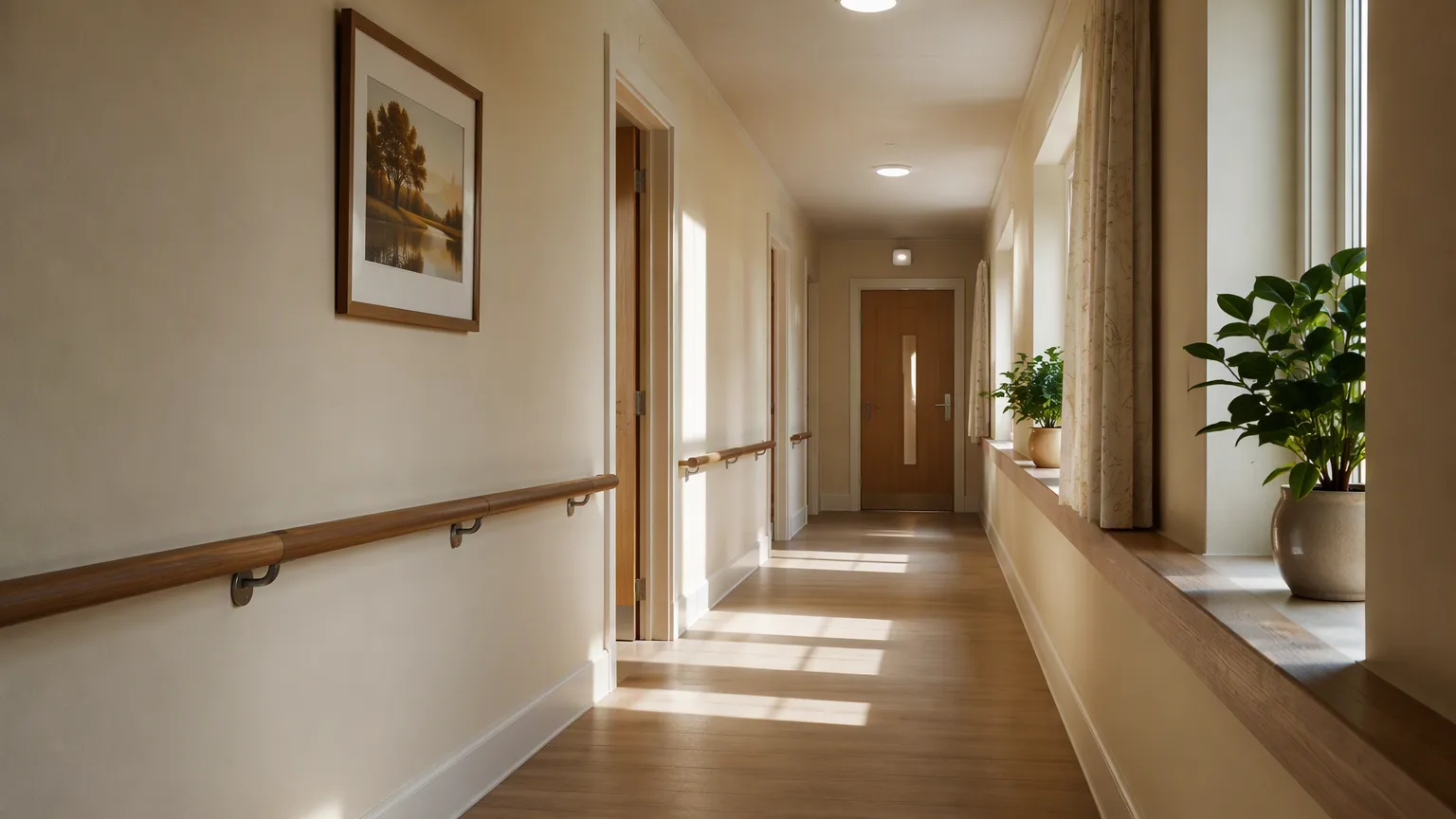
A great deal of exit-seeking starts with an ordinary unmet need rather than with the front door. The Code of Practice treats the environment as one of the alternatives that should be tried before restraint, and the measures it names at paragraph 12.7.5(e) are concrete: removing furniture with sharp edges, strengthening signage that guides residents to bedrooms, assisting with suitable footwear and appropriate use of walking aids, providing good lighting, installing bed monitoring systems, ensuring correct posture for residents in wheelchairs, and applying the brakes to movable objects such as beds, wheelchairs and commode chairs.
Read as a list, that is a walk-through of the home at the height of a resident's eye. Does the corridor lead somewhere that looks like somewhere, does the toilet announce itself, is the lighting even, and is the quiet corner at the end of the corridor a place someone would sit down and stop. The same walk-through is worth repeating after any change of layout, because a route that was legible last year may not be legible now.
Doors and locks, and the line the guidance draws
Paragraph 12.9.2 of the Code of Practice asks each home to formulate effective guidelines to identify residents with wandering behaviour, and to provide appropriate facilities to prevent them from leaving the home unnoticed or entering restricted areas that are not open to them. Paragraph 7.2.1 names the kinds of facility it means: window grills and openable window grill locks, closed-circuit television systems, digital door locks and sensory alarms, all kept in working order, inspected and maintained regularly, with records of that maintenance kept.
The Hong Kong Alzheimer's Disease Association's guidance on protecting a person from wandering and getting lost sits next to that requirement and qualifies it. It advises informing neighbours and local emergency responders and keeping a list of their names and telephone numbers, installing deadbolt or slide-bolt locks on exterior doors, and limiting access to dangerous areas. In the same list it states plainly: never lock the person with dementia in a home without supervision.
Those two documents are not in conflict. The Code asks for facilities and for the guidelines and staff that make them safe, and the association's warning explains why a locked door without supervision is not one of them. A door that holds a resident in is only as good as the person who knows it is closed, who can open it in seconds, and who is accountable for the decision in writing.
Sensors, cameras and what technology can and cannot cover
The Code of Practice expects the home to be equipped with closed-circuit television systems that have recording functions, and to comply with the Privacy Commissioner's guidance on CCTV surveillance when deciding the scope of monitoring and the locations, which the Code describes in terms of public areas, interview rooms, entrances and exits so that personal privacy is protected.
For wandering specifically, the honest description of the technology is a division of labour. A door contact or a sensory alarm tells the team that someone has passed a point, which is a report rather than a prevention; a bed or chair sensor tells the team that a transfer has begun; a camera with recording helps locate the last known position when a resident cannot be found. A bathroom light that switches itself on before the resident has to find a switch addresses the night-time trip that produces a large share of falls, and it has nothing to do with exits at all.
What no sensor does is decide. An alert that nobody reaches in two minutes is a log entry. Homes that get value from monitoring tend to be the ones that have written down what the response is, who owns it on each shift, and what happens at 3am when the corridor is covered by one person; the privacy design behind posture-based, on-device detection is described in our note on privacy-preserving vision in aged care.
Restraint: the last resort, and the procedure around it
Hong Kong sets the restraint rules in two places. Regulation 33A of the Residential Care Homes (Elderly Persons) Regulation (Cap. 459A) states that a restraint must not be used on a resident unless the safety, health or well-being of the resident or other persons is endangered, no other less restrictive means to avoid the danger is available in the circumstances, and the consent requirements in the Code of Practice are complied with. It adds that a restraint may only be used in the safe and proper manner set out in the Code and for no longer than is necessary, and that its use must be closely monitored and reviewed.
The Code of Practice then describes what that means day to day. Restraint should be avoided whenever possible and considered only where no less restrictive means is available or in an emergency; it is not a usual practice, not a punishment, and not a substitute for care or for staff convenience. Alternatives are to be attempted and recorded, written consent is required in advance on the form at Annex 12.4, the resident has to be observed with the restraint released for examination at least once every 2 hours, the observation record has to be signed immediately, a home manager, nurse or health worker has to conduct a random check on every resident under restraint at least once a day and countersign the record, and the need for continuing restraint has to be reassessed at least once every 6 months or whenever the resident's condition changes, with consent obtained again.
The Nursing Council of Hong Kong's Guide to Good Nursing Practice on physical restraint frames the same position from the clinical side: it notes that the application of physical restraint curtails freedom and could be viewed as a form of assault, battery or even false imprisonment, that restraint is justified only as a last resort to prevent imminent danger after less restrictive options have failed, that it should be applied in the least restrictive form and over the shortest duration, and that it should be documented for record and inspection purposes. A care home that has a resident under restraint without the assessment, the consent, the two-hourly record and the review is not managing a risk; it is accumulating findings.
Interventions compared: what each addresses, who it depends on, its main limitation
The table compares the options a home actually has. The limitation column is the one worth reading first, because most wandering plans fail there rather than in the idea.
| Intervention | What it addresses | Who it depends on | Main limitation |
|---|---|---|---|
| Wayfinding: signage to bedrooms, even lighting, removal of sharp-edged furniture | Restlessness and disorientation inside the home | Whoever walks the route and records the check | Depends on cues the resident can still use; a change of layout undoes it |
| Structured activity: exercise groups, assisted walking, daily activities | Restlessness, agitation and long empty hours | Activity staff and the daily programme | The resident has to be willing to join in, and the activity has to be repeated |
| Camouflaging a door or placing a mirror near it | Exit through one particular door | Whoever sets it up, in minutes | Addresses that door, not the wish to leave; another exit may be used |
| Door contacts and sensory alarms | The moment someone passes a monitored point | Staff who respond, plus maintenance and records | It reports an exit rather than preventing one; an unanswered alert is only a log entry |
| Digital door locks and controlled exits | Unauthorised exit from the building | Staff with keys or codes, and a written basis for the control | The association's guidance is never to lock a person with dementia in without supervision |
| CCTV with recording at entrances and exits | Locating a resident and reviewing what happened | Staff who watch and review, and compliance with privacy guidance | Usually retrospective; scope and purpose have to be justified |
| Bed and chair monitoring systems | Unassisted transfers and night-time movement | The nurse or health worker on duty | Detects movement, not its reason; needs a response, not just a display |
| Wearable locating device or pendant | Finding a resident who has already left | The resident keeping it on | The person most likely to walk out is often the one who removes it |
| Physical restraint, assessed and consented | Immediate danger identified in the assessment | A medical practitioner, consent, two-hourly observation, review at least every 6 months | Last resort, least restrictive, shortest time; the WHO notes restraints are used widely even where regulations exist |
Two rows are cheap and immediate, and they are the ones most often skipped: walking the route with the resident in mind, and answering every alert. Everything above them in cost depends on those two.
The first hour after a resident is missing
The Code of Practice is specific about the immediate steps. Where a resident wanders away while being escorted outdoors, or while being accompanied on an activity out of the home, staff are to report to the home manager immediately and take follow-up action; the home is also to inform the resident's guardians, guarantors, family members, relatives or contact persons; and where necessary the resident is to be sent to hospital or reported to the police immediately for assistance.
A missing resident who needs police assistance is separately listed as a reportable event under the Code's Special Incident Report, the form the home completes for an unusual death, an incident causing serious injury, a missing resident requiring police assistance, established or suspected abuse, or a significant dispute. The report sits alongside the Accident Record, which is to be written up instantly, and the log book that the staff on duty keep for irregularities and follow-up.
What the first hour should produce, in practical terms, is four facts before the shift changes: the time the resident was last seen and by whom, the route out, what they were wearing, and who has already been called. The association's protective advice adds one piece of preparation that has to exist before the event: a list of neighbours and local emergency responders with names and telephone numbers. A list assembled after a resident is missing is a list assembled too late.
What the family should know, and when
The Code of Practice requires the home to inform the family in the situations it describes, and the care team's judgement is about how much detail, not about whether to make contact. A family that learns about a near-miss from a neighbour rather than from the home stops trusting the home's reassurance, and a home that has already decided what it will tell families about wandering is a home that will not improvise at 4am.
It helps to settle four questions in advance and write the answers down. Who calls the family, in what order, and within what time; what the family will be told about the guidelines the home has for identifying wandering behaviour; what the family is asked to bring, such as a recent photograph and a list of the places the resident might try to reach, because a former workplace or an old address is a realistic destination; and what changes after an incident, since a plan that does not change is a plan that did not learn anything.
Two things belong with a professional rather than with this article. Where a family is considering a secured area or any restriction of a resident's movement, the decision and the consent process are governed by the Code of Practice and by the resident's circumstances, and the home's own procedures and legal advice should be followed. Where the behaviour has changed quickly, that is a clinical observation for the resident's medical practitioner, not something for a shift to interpret. The care team's part is to record what was observed, attribute it to the hour and the place, and put it in front of the person qualified to act on it.
Explore more
- SilverGuard Insights on aged care safety : the full archive on falls, incidents, records and monitoring.
- Care home inspection preparation in Hong Kong : the inspection file that has to hold the wandering, restraint and incident records.
- Privacy-preserving vision in aged care : what a corridor camera can detect without recording residents continuously.
- Practical fall prevention in a care home : the night-time route and lighting checks that reduce one common reason to get up.
- Steadicore : the sensing side of our family of products, including door and zone monitoring.
- Our FAQ : deployment, alerting and privacy questions we are asked most often.
Related notes
- Residential Care Home for the Elderly: Types and Subsidies
Residential care homes for the elderly in Hong Kong fall into four operating types and three care levels, and only some places are subsidised.
- Care Home Inspection Preparation in Hong Kong
Preparation for a care home inspection in Hong Kong: the licence, the Code of Practice records an inspection asks for, and the certificates behind them.
- Care home staffing ratio in Hong Kong: what the Code sets
Hong Kong care home staffing ratio: the minimum headcount the Code of Practice sets, by staff grade, home type and shift, including the night requirement.