
Bed Exit Alarms in Care Homes: Choosing and Using Them
SilverGuard Technologies Limited7 min read
Bed exit alarms alert staff when an at-risk resident begins to leave their bed. That shortens response time but does not by itself prevent a fall. A pressure pad, an infrared beam and a wearable each sense a different signal, so the choice is about who needs the alert, where the device sits, and what staff do when it sounds.
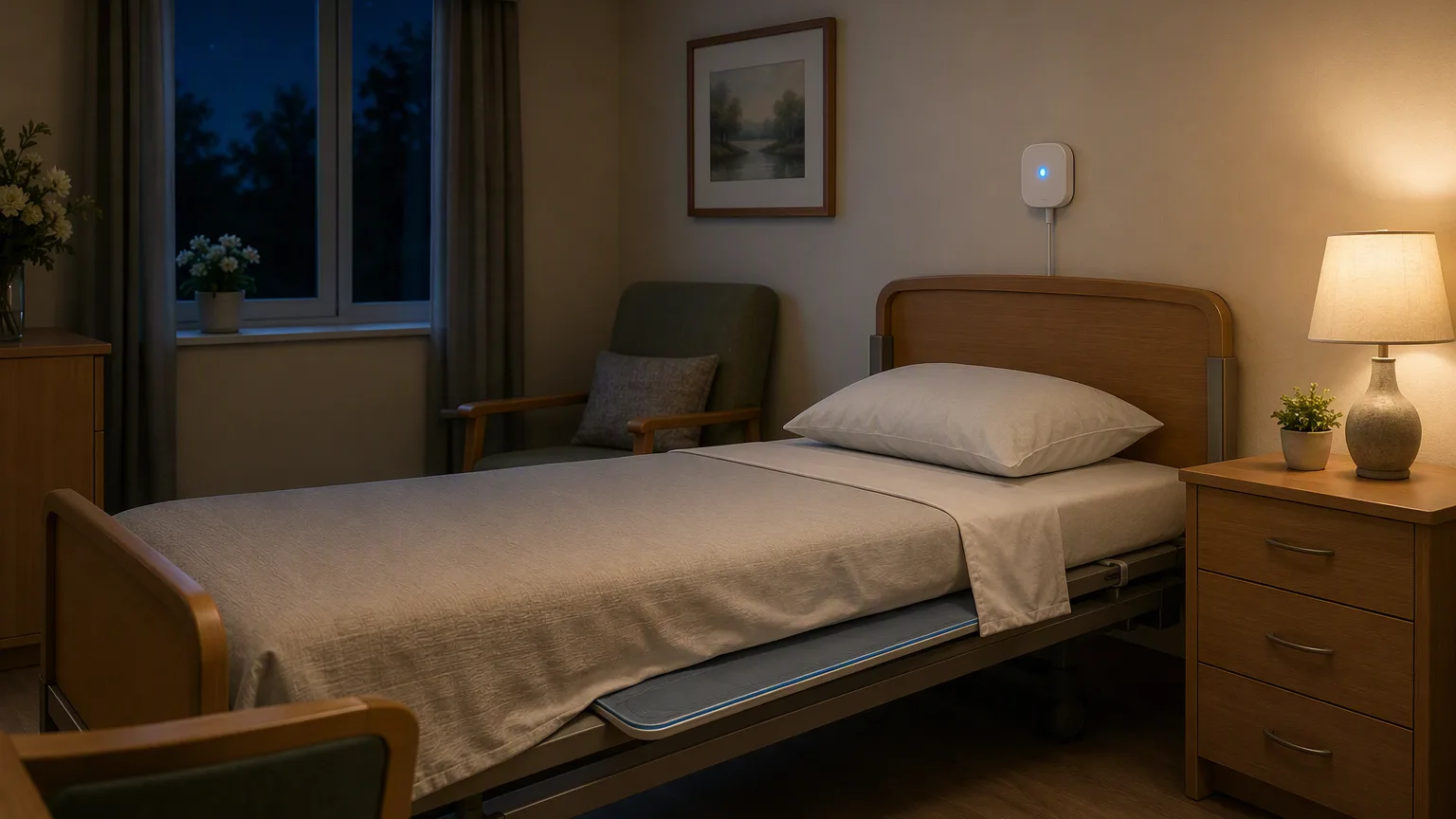
What a bed exit alarm is, and what it is not
A bed exit alarm is a monitoring device that raises an alert the moment an at-risk resident begins to leave their bed, before they are fully up and moving. It is not the same thing as a fall detector, which senses a fall after it happens, and it is not the same as a personal alarm pendant, which only works when the resident presses a button. A bed exit alarm sits between the two: it does not wait for a fall and it does not need the resident to act.
Its value is time. The seconds between a resident getting up at night and reaching the toilet or the door are when most unwitnessed incidents begin, and an alarm that fires at the first movement hands those seconds to a member of staff. That is why a bed exit alarm belongs inside a fall prevention system, not on top of it as a badge.
The three sensor types, and the signal each one senses
Most bed exit alarms sold to care homes fall into three families, and they differ in what they actually sense. The choice between them is a decision about who the resident is and where the device must sit.
- Pressure pad: a flat sensor under the sheet or on the mattress that triggers when the resident's weight lifts off it. It is the cheapest and most common, but its position has to be checked every shift because a pad that has slipped no longer senses what it should.
- Infrared beam: an invisible beam across the edge of the bed or the doorway that triggers when the beam is broken. It can cover a wider area than a pad and does not depend on weight resting in one spot, but it needs to be angled so an arm or a passing blanket does not set it off.
- Wearable: a pendant or watch with automatic motion and posture sensing that travels with the resident. It works wherever the resident goes, including the bathroom, but it only works while it is worn, and a device left on the charger senses nothing.
What the evidence actually says
The honest reading of the research is that a bed exit alarm is an alerting tool, not a prevention guarantee. A peer-reviewed study published in the Archives of Gerontology and Geriatrics compared a pressure-sensitive alarm with a dual sensor that added an infrared beam and found the dual sensor identified bed-exit movements more accurately while producing fewer false alarms, but false alarms were not eliminated, and the authors conclude plainly that alarms are not a substitute for staff.
A systematic review of alarm devices in long-term care makes the same point from the other direction: alarms work best as one part of a broader plan of care, and the recurring reasons they fail are alarm fatigue, poor implementation and the noise itself, which in some cases is described as a possible cause of falls. The evidence does not say alarms are useless. It says they earn their place by being chosen, placed and answered properly.
Matching the alarm to the resident
The right alarm is the one that matches how the resident actually moves, not the one with the longest feature list.
- A resident who can stand unaided and is restless at night needs an early alert, a pressure pad or infrared beam that fires before they are fully out of bed.
- A resident who is largely immobile may only need a floor mat or bed alarm as a second layer, because unsupported standing is unlikely.
- A resident who wanders or is confused needs the bed alarm paired with the exit and door monitoring already required for dementia wandering safety, not used as a substitute for it.
- The night-time toilet run is where the alarm earns its keep, and it only covers the moment of getting up; the route itself still needs the checks in our night-time falls guide.
Placement and tuning decide whether it helps
A bed exit alarm that fires constantly is ignored, and one that never fires is decoration. Both failures come from placement and tuning, not from the hardware.
- Pad position: under the sheet at the point where the resident's weight actually rests, and re-checked at every handover.
- Beam height and angle: set so a resting arm or a kicked blanket does not trip it, and tested against the resident's own movements rather than a staff member's guess.
- The alert must reach the person who can act: a nurse call system or pager, not a sound lost in a corridor.
- Volume and tone: loud enough to be heard, not so startling that the sound itself causes the very fall it is meant to prevent, a risk the systematic review names directly.
Hong Kong: funding and what the Code of Practice requires
Hong Kong guidance treats sensor alarms as part of a care home's duty, not an optional extra. The Social Welfare Department's Code of Practice for Residential Care Homes (Elderly Persons) lists sensor alarms among the facilities a home is expected to keep in working order for residents who are at risk of wandering.
Funding exists for the purchase. The Innovation and Technology Fund for Application in Elderly and Rehabilitation Care, established in December 2018 with HK$1 billion and topped up with a further HK$1 billion in 2024-25, subsidises eligible elderly and rehabilitation service units to buy, rent or trial technology products. Since the eighth batch in September 2022, eligibility has extended to non-subsidised private and self-financing homes. The fund publishes an approved product reference list for each batch, so a home should confirm a bed exit alarm system is listed before it applies.
Putting the alarm into a response routine
A bed exit alarm is only as good as what happens after it sounds. The device buys seconds; the routine decides whether those seconds become an intervention.
- Name who answers and how fast, and carry that name through the handover so it is not re-decided every shift.
- Record every alert and near-miss so the home can see patterns over time instead of anecdotes.
- Review false alarms monthly, not only after a resident falls, because a rising false-alarm rate is an early warning that a device has drifted out of place.
- Zone-based monitoring extends the same idea from the bed to the whole room: choosing a fall detection system covers how to compare those options, and the sensing and risk-prediction side is what Steadicore builds in our own family. How we keep that monitoring privacy-preserving is in our FAQ, and which figures we publish rather than claim is on our impact dashboard.
Frequently asked questions
- Does a bed exit alarm guarantee a resident will not fall?
- No, and no device should claim that. An alarm shortens the time between a resident leaving bed and a staff response, and it produces a record of the event. Prevention comes from the wider system, the risk factors, the environment and the staffing rhythm, which the alarm supports rather than replaces.
- Can a care home use the Hong Kong gerontech fund to buy one?
- Eligible elderly and rehabilitation service units can apply through the Social Welfare Department's Innovation and Technology Fund for Application in Elderly and Rehabilitation Care to purchase or rent approved technology products, which can include bed exit alarm systems. Confirm the product is on the current batch's approved reference list and check the application window on the fund's page.
Explore more
- Fall prevention in care homes : where a bed exit alarm sits within the wider falls system.
- Bed rails, restraint and the alternatives : why a sensor is preferred over a physical barrier, and how the decision is documented.
- Why falls happen at night : the toilet route and the round design, the two things an alarm cannot fix.
- Fall detection sensor versus personal alarm : which one covers a bed exit, and which one only covers a fall that already happened.
- Our FAQ : alerting, records and privacy questions we are asked most often.
- Steadicore : Wi-Fi sensing that reads movement in the room without a camera, as an alternative to a mat or a beam.
- Easikin : an SI caregiving assistant for adult children coordinating a parent's care.
Related notes
- Residential Care Home for the Elderly: Types and Subsidies
Residential care homes for the elderly in Hong Kong fall into four operating types and three care levels, and only some places are subsidised.
- Loneliness in Care Homes: What Activities Are For
Loneliness in care homes is not the same as being alone. Here are the risk factors Hong Kong guidance lists, the Code's requirements, and what works.
- Restraint Use in Care Homes: The Law and What to Try First
Restraint use in care homes is governed by section 33A of Cap. 459A, the Code of Practice and Nursing Council guidance. The frame, and what to try first.