
Manual Handling Injury Among Care Home Staff in Hong Kong
SilverGuard Technologies Limited9 min read
Manual handling care home staff injuries in Hong Kong are managed under Part VII of the Occupational Safety and Health Regulation, which requires a risk assessment, avoidance of the lift where possible, mechanical aids or team lifting, and training. The Department of Health publishes eight lifting and transfer principles for carers.
Why this injury empties a roster faster than an accident does
The Labour Department is direct about which harm leads the list. In its guidance on manual handling in health care services, it states that among the many potential health hazards at work, low back pain tops the problematic list, that nurses in hospitals and personal care workers in nursing homes are the main victims, and that the condition normally occurs not because of accidents but because of repeated handling movements and awkward working postures. The consequence is written for the supervisor as much as for the worker: the injured employee may need long sick leave or end up giving up the career, while the employer pays for sick leave, compensation and the permanent loss of skilled workers [Labour Department, Manual Handling in Health Care Services, first edition January 2000].
Its companion guide on manual handling of patients sets out where those loads come from in a care setting. Awkward postures when handling patients are likely to cause sprains, strains and back injuries, and some injuries cause instant pain while others appear only after a period of work. The listed causes are ordinary care tasks: overloading the back by bending excessively to help a bedridden patient sit up, excessive twisting and over-reaching while helping a patient transfer from a bed to a wheelchair, transporting a patient in the wrong manner, unexpected weight bearing, lifting operations that exceed an employee's individual capability, insufficient space to keep a correct posture, and wet or slippery floors [Labour Department, Health Care Services: Manual Handling of Patients, edition 2004].
The Regulation's own list of what makes an employee unsuitable for a lift on a given day includes shoulder and upper limb complaints alongside back pain. In assessing an employee's capability, an employer must take into consideration any report or concern raised by that employee about their health which may make them unfit for manual handling operations on the day of work, with physical injuries, symptoms of musculoskeletal disorders such as aches and pains in the back, shoulders, arms, wrists or hands, and pregnancy or health problems such as hernia or a record of major injury or surgery all named as examples, as the Labour Department's A Guide to Part VII of the Occupational Safety and Health Regulation (Manual Handling Operations), November 2005 edition, sets out at section 30.
What the law requires before anyone is lifted
Part VII of the Occupational Safety and Health Regulation (Cap. 509A) has governed manual handling operations at work since 1 July 1998. Under section 23, the person responsible for a workplace must make a preliminary risk assessment of a manual handling operation before it is first undertaken there. If the preliminary assessment reveals that the operation may create safety and health risks, the responsible person should, as far as reasonably practicable, avoid the need for employees to perform that operation at all, and where the risks are avoided, no further action is required [Part VII guide, section 1.1].
Where the operation cannot be avoided, a further risk assessment is required under section 25, and the guide lists what it must address: the nature of the tasks, the characteristics of the loads, the conditions of the working environment, the individual capability of employees, and other related matters such as whether protective equipment or clothing hinders movement or posture [Part VII guide, section 1.2, referring to Schedule 3 of the Regulation]. Both assessments are reviewed whenever they are no longer valid or the circumstances have significantly changed, for example where the operation is carried out in a different environment, practised in a significantly different manner or involves much heavier loads, and modified as soon as reasonably practicable when the review indicates the need [Part VII guide, section 1.5].
The same Part of the Regulation carries duties that a care home has to be able to evidence. Where 10 or more employees are normally employed to carry out hazardous manual handling operations, records of the preliminary and further assessments and their reviews must be kept, legible, for a period of not less than three years, and available for inspection by an Occupational Safety Officer on request; in the same circumstances a competent person must be appointed to assist in implementing the preventive and protective measures [Part VII guide, sections 2.2, 2.3 and 4.1]. Section 27 requires appropriate steps to reduce the risks identified and to provide employees with information on the weight of each load, mechanical aids and protective equipment, and states that team lifting of loads should be adopted in any manual handling operation whenever it is reasonably practicable. Section 29 requires relevant information to be given before hazardous operations are undertaken, and section 31 requires adequate training covering safe work practices, optimum use of bodily effort, proper use of mechanical aids and protective devices, and accident reporting procedures [Part VII guide, sections 3.2, 5.1].
In a care home the load is a person, which the health care guidance treats as its own problem. The employer has a duty to provide employees with general indications and, where practicable, precise information on the weight of each load, so if a resident's weight has already been recorded it should be made known to the employees required to lift or handle that resident, and where no such information exists the resident may be asked about their approximate weight or an estimate should be made. The same section notes that the person being handled can assist or hinder the employee, that additional or sudden force may be needed in response to unexpected movement such as a person slipping while being assisted to walk, and that where heavy people are handled, more care is needed in the assessment and in the control measures [Manual Handling in Health Care Services, section 3.2].
The eight principles of safe transfer
The Department of Health's Elderly Health Service sets out, in its guidance on lifting and transfer, the sequence a carer is expected to follow as eight principles, published for both domestic and institutional carers. The service asks carers to consult a physiotherapist or other health professional where a technique or a related device is in doubt, which is the honest boundary of any written guidance on handling a person.
The Department of Health's video series on lifting and transfer works through three cases of differing physical condition: an elder who is slightly weak and needs one carer to assist, an elder who is weak on one side of the body and needs mild assistance, and an elder who is overall weak and needs two carers to assist. The third case is the clearest statement in the Hong Kong material that a two-carer transfer is the answer for a resident who cannot be handled by one person.
- Plan ahead and be prepared: adopt an appropriate lifting or transfer method after understanding the condition and ability of the elder, ensure a safe environment, and prepare and secure the equipment, including the correct orientation of the chair or wheelchair and locking the wheelchair.
- Explain to the elder and give guidance: gain cooperation and participation by explaining the procedure.
- Maintain correct posture: protect the back by keeping it straight and tightening the abdominal muscles, and stand with feet apart and knees bent.
- Hold firmly: a firm hold enhances safety and gives the elder a sense of security.
- Stay close to the elder: keeping the elder as close as possible protects the carer's back.
- Point one foot towards the destination and lift with the strength of the lower limbs: this facilitates proper weight shifting and propels with the legs rather than the back.
- One carer gives the command: seek help from family members or colleagues when necessary, and assign only one carer to give the command, so that coordination prevents injury.
- Use assistive devices: use lifting and transfer aids appropriately to decrease strain and injury.
What a hoist, a sling and a slide sheet each do
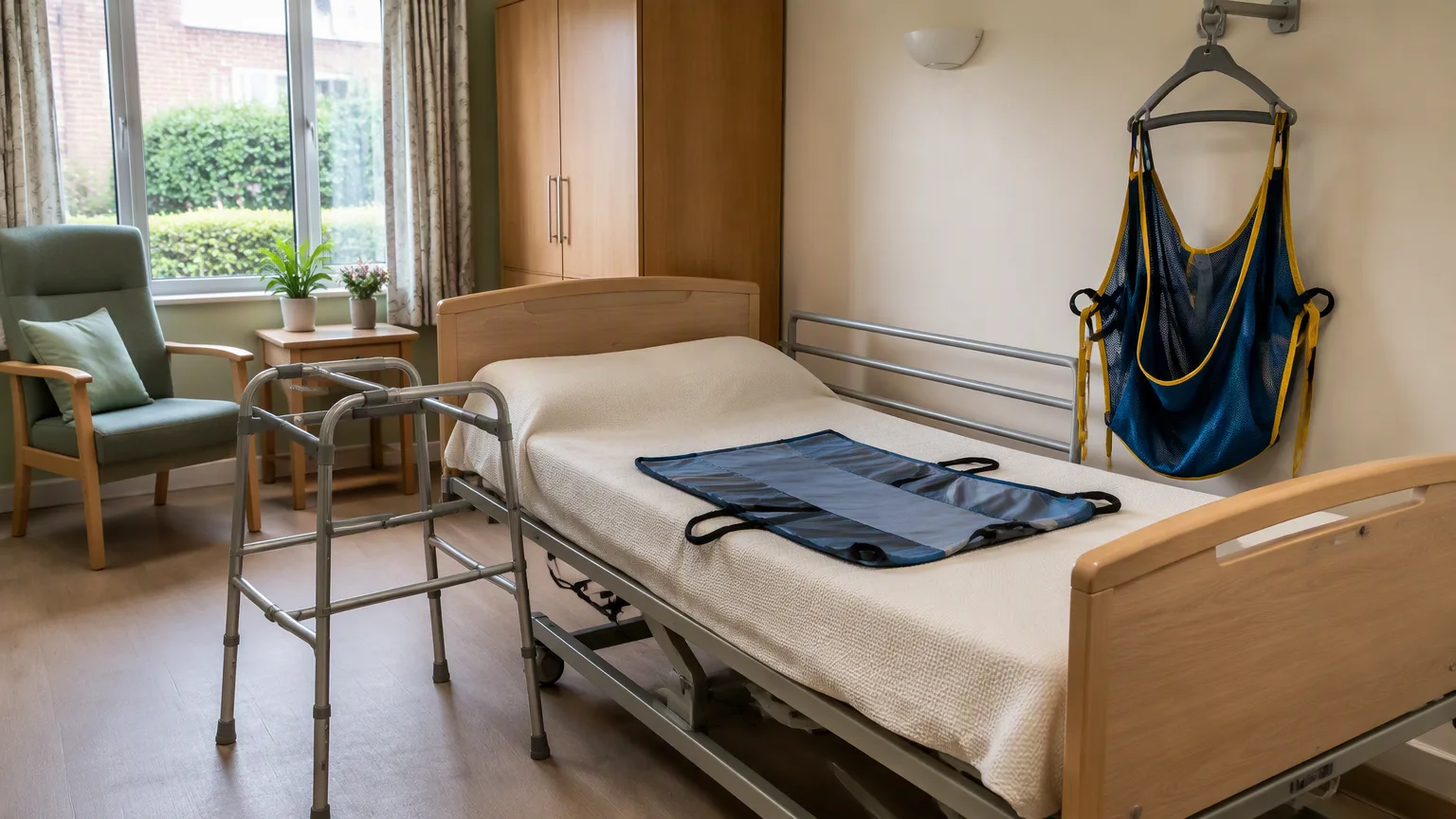
The Labour Department's health care guidance draws the distinction that decides which aid is brought into the room. Mechanical aids can support the full weight of the load, for example certain patient hoists and lifters; non-mechanical aids support a portion of the load weight, which makes supporting the load easier or eliminates part of the handling task, and patient handling slings and sliding aids are given as examples. Where equipment of this kind is in use, the maximum weight which may be lifted should be clearly marked, all equipment must be properly maintained, and a central inventory of less frequently used special equipment should be kept so that items can be shared between areas as demand varies [Manual Handling in Health Care Services, section 4.5.2].
Height is a control measure in its own right. A horizontal transfer can be made without actually lifting a person if the bed or trolley can be adjusted to the height of the chair or trolley the person is being transferred to, for example adjusting the bed height to that of a wheelchair so that the transition is smooth and needs minimal assistance. Where transfers cannot be performed on the same level, it is safer to move a person from a higher to a lower level than to lift the person from a lower to a higher level, and the best height range for handling people is around the employee's waist level, with lifting preferably between the hips and the shoulders [Manual Handling in Health Care Services, section 4.1].
A care home also has licensing duties attached to the equipment, set out in the Code of Practice for Residential Care Homes (Elderly Persons), June 2024 (Revised Edition). Before using electrical furniture and equipment such as a lifter or hoist, the home should arrange relevant staff training and formulate operation guidelines for staff to refer to and comply with, should regularly inspect and repair the equipment and should keep maintenance records [Code of Practice for Residential Care Homes (Elderly Persons), June 2024 (Revised Edition), paragraph 7.1.3]. A lifter or hoist is listed among the equipment a home provides depending on needs, together with walking aids and wheelchairs and fall prevention facilities such as bed rails or a bed monitoring system [Code of Practice 7.11]. The Code also requires an operator to arrange for staff to receive training and supervision related to personal care and nursing care skills such as lifting and transfer, feeding and bathing, and to consult the relevant guidelines and healthcare professionals' advice [Code of Practice 12.4.5].
What the sources actually say about thresholds
The one figure that appears in the Hong Kong guidance is a trigger for a further assessment rather than a limit. The appendix to the Part VII guide explains that its weights apply to a simple lift or lower by an adult male operator working under optimum conditions, that where the hands enter more than one zone during the operation the smallest weight figure should be used, that for female operators the figures should be reduced by one third as a rough guide, and, in the guide's own words, that the given figures are not weight limits. Two statements in that appendix matter to a care home: strenuous effort is usually required to handle a load greater than 16 kg without mechanical aids such as trolleys or other simple lifting equipment, and even when the operation is performed under optimum conditions, a further assessment is needed if the weight of the load approaches 16 kg [Part VII guide, Appendix III].
No source in the Hong Kong material fixes a single weight above which a hoist must be used, and presenting one would be invention rather than citation. What the sources state is the direction of the decision: the operation is to be avoided where reasonably practicable under section 24, team lifting is to be adopted in any manual handling operation whenever it is reasonably practicable under section 27, and the health care guidance adds that where heavy people are handled, more care is needed in the assessment of risk and in applying control measures. Where a hoist or lifter is in use, its conditions are equipment conditions: the maximum weight which may be lifted should be clearly marked on it and the equipment must be properly maintained.
On the number of staff, the Regulation states a principle rather than a figure, and the health care guidance explains how to apply it. Team lifting of loads should be adopted in any manual handling operation whenever it is reasonably practicable, and the guidance adds that the regular need for team lifting usually signals the need for job redesign, while the introduction of team lifting may be effective in reducing the risks of lifting and transferring a seriously incapacitated person. Where team lifting is used, the lift must be coordinated and carefully planned, an adequate number of persons must be in the team, one person is appointed to coordinate the lift and instruct, and where possible the lift, including what to do in an emergency, should be rehearsed [Manual Handling in Health Care Services, section 4.2]. The Department of Health material shows the two-carer case as the arrangement for a resident who is overall weak. Nothing in the Hong Kong guidance converts a resident's weight into a carer number: that is the further assessment, made for that resident and reviewed when their condition changes.
What a resident's mobility assessment must record, and who reviews it
In a care home the handling assessment sits inside a second document. The Individual Care Plan must include a mobility assessment, a self-care ability assessment, an assessment of risk factors and preventive measures, the resident's mental state, medical history, an assessment of nursing care needs and a nursing care plan, personal habits and daily activities, and a rehabilitation need and plan [Code of Practice 12.3.3]. The plan is formulated jointly with the resident and the guardians, guarantors, family members or relatives within one month after admission, first reviewed six months after the first plan was formulated, and then reviewed at least annually or when the required care services have changed, with the records maintained [Code of Practice 12.3.2].
The record side has its own requirement. A home shall properly maintain and update the Personal Health and Nursing Record of each resident, covering medical examination forms, medical history, hospital admissions and discharges, medical consultations and follow-up treatment, health condition assessments including activities of daily living, and special nursing care needs and nursing records such as incontinence care and the use of feeding tubes or urinary catheters [Code of Practice 12.5]. The Code also requires appropriate measures, including placing signs near the bedsides of residents or other suitable locations, for identifying the special nursing care needs or risk factors of residents, with allergies, falls and swallowing difficulty given as examples [Code of Practice 12.4.4].
The supervisor's question is therefore not whether a mobility assessment exists. It is whether the last review date is inside the interval the Code sets, and whether the transfer method written in the plan is the method staff actually used on the last shift. The health care guidance adds the practical layer that answers it: a generic assessment may be prepared for categories of handling task such as bed to chair or wheelchair to toilet transfers, but whenever a particular task is carried out there should be an on-the-spot assessment by the people actually carrying out that task, to determine whether the generic assessment adequately reflects the risk involved, and if it does not, a specific assessment will be necessary [Manual Handling in Health Care Services, section 3.3].
The training and refresher a home must be able to show
Section 31 requires an employer to provide adequate training, and the Part VII guide sets out the minimum content: safe work practices, optimum use of bodily effort, proper use of mechanical aids and protective devices, and accident reporting procedures. New employees should be provided with relevant safety and health training in addition to job training, refresher training should be provided when necessary and especially for occasional workers, task-specific training is helpful for reducing hazards in high risk operations, and all such training should be provided during the employees' normal working hours [Part VII guide, section 5.2].
The health care guidance is more specific about timing. Appropriate training must be provided to all staff groups before any people handling tasks are performed, which may form part of a general induction programme, and refresher and in-service courses are needed as a regular part of the training programme. A recall system ensuring that all staff, including part-time staff, have time set aside at least once a year for refresher training is described as essential, and additional training may be identified after an injury or an incident investigation. Line managers also require training so that they can supervise and monitor established safe practices, contribute to handling assessments, investigate accidents and identify further needs. As a minimum, training covers the work risk factors that contribute to injury, guidance on evaluating the environment, task, load and individual capability, the principles of health care and injury prevention through work organisation, workplace design and the use of appropriate equipment, and instruction with supervised practice of handling techniques and equipment in the workplace [Manual Handling in Health Care Services, section 4.7].
The licensing Code requires the training to be recorded. The operator and the home manager should arrange continuous on-the-job training and supervision for staff, covering occupational safety, stress management, infection control, drug management, nursing care, handling suspected abuse incidents, use of restraints and protection of residents' privacy, and attending to safety and health at work in particular through proper manual handling techniques for elderly care, increased awareness of drug safety management and effective infection control measures, with staff meetings and retreat days used for sharing information and the corresponding records maintained [Code of Practice 9.4.3]. Training and supervision in lifting and transfer are named in the care chapter as well [Code of Practice 12.4.5]. A certificate from three years ago is not a training record; a training record is a list of names, dates, content and who delivered it, and it is the only way to show that a new starter on the night shift was taught the method the care plan assumes.
The near miss log and what a supervisor does with it
Accident reporting procedures sit inside the training requirement under section 31, which is the reason a home's practice on near misses is a training and supervision matter rather than a filing preference. Where the training did not cover what to do when a wheelchair lock fails, the record of the failure will not exist either.
The health care guidance asks employers to act on early warning signs rather than on completed injuries. Employees who experience early features of pain or other symptoms thought to be associated with people handling should be encouraged to see an occupational health physician for early assessment, and an employee injured as a result of people handling should be offered early assessment, with a rehabilitation programme planned according to the individual's needs, monitored, the principles of health care reinforced, the working environment in which the injury occurred reviewed, reassessed and improved if necessary, and a final assessment made by the physician about suitability for return to full duties. Employees should be actively encouraged to inform their manager and seek health advice for cumulative strains or pains [Manual Handling in Health Care Services, sections 4.8 and 4.9].
Investigation is the part a supervisor owns. A thorough investigation of people handling incidents, whether statutory reportable or not, should yield data that identifies causes, the level of compliance with current legislation and particular trends or problem areas needing better preventive measures, and the investigation report should give a factually accurate account of the circumstances and identify the causes or contributory factors. The guide's own example is worth repeating at handover: an investigation that reveals a worker suffered a back injury because the bed onto which the patient was being lifted moved should identify why the bed moved, which may be faulty wheel locks or locks not properly applied. Effective action after an accident has to be based on properly identified causes rather than on the immediate circumstances of the accident [Manual Handling in Health Care Services, section 4.9].
The home's own record system supplies the timing. The accident record required by the Code of Practice has to be written up instantly, with the date and time, what happened, the resident's condition, who was informed and when, and the remedial action [Code of Practice 8.7.2(b); regulation 16(e) of the Residential Care Homes (Elderly Persons) Regulation (Cap. 459A)]. A near miss that harmed nobody belongs in the same investigation habit, with the same questions: what moved, what was not locked, what could the staff member not reach, and what changed as a result. Where an injury is serious, or a resident has been harmed, the Special Incident Report routes the case to the Licensing Office, and where a claim or a statutory report is possible, the home needs professional advice rather than an article.
The transfer method, when it applies, and what it takes
The table sets out the transfer methods that appear in the Hong Kong sources, the circumstance each one is described for, and the equipment and staff it takes. The staff column follows the sources and the assessment, not a house rule: where a source does not state a number, the assessment for that resident is what decides.
| Transfer method | When the sources say it applies | Equipment it needs | Staff it takes |
|---|---|---|---|
| Supervised transfer, with the resident standing and stepping | The mobility assessment records that the resident can stand and step with an aid | Walking frame or handrail, chair or wheelchair positioned and locked | One carer to supervise |
| Light assistance transfer | The Department of Health case of weakness on one side of the body needing mild assistance | Slide sheet or transfer belt, height adjustable bed | One carer |
| Two-carer transfer with a slide sheet | The Department of Health case of a resident who is overall weak, and any resident who cannot be transferred by one carer | Slide sheet or sliding board, transfer belt, one named coordinator | Two carers |
| Hoist or lifter transfer | The resident cannot take weight, or the further assessment shows the transfer cannot be made safe by hand | Hoist with a sling matched to the resident, written operating guideline, inspection and maintenance records | The trained staff the home's operating guideline and the resident's assessment state |
| Bed to chair lateral transfer at the same level | The bed can be adjusted to the height of the chair, so the resident can be moved without being lifted | Height adjustable bed, sliding aids, locked chair | The number the assessment records |
| Team lift of a seriously incapacitated resident | Where team lifting is introduced, the Labour Department guidance noting that a regular need for it usually signals the need for job redesign | None beyond the aids already in use, with the lift planned and rehearsed | An adequate number of persons, with one appointed to coordinate and instruct |
Three things follow from the table. The first is that the decision document is the resident's own assessment, not a general rule about weight, because no source states one. The second is that the equipment matters only with the training and the written guideline behind it, which is what the licensing Code requires before a lifter or hoist is used at all. The third is that where the technique or the device is in doubt, the Department of Health material directs the carer to a physiotherapist or other health care professional, and in a care home that route runs through the resident's care plan rather than around it.
Explore more
- SilverGuard Insights on care home operations : the wider archive on staffing, falls and records in residential care.
- Care home staffing ratios in Hong Kong : why a handling injury is a roster problem, and what the staffing tables require.
- Fall prevention in a care home : the other half of safe mobility, and the bedside sign that identifies both risks.
- Risk assessment in a care home : how a handling assessment sits with the other assessments a home maintains.
- Our FAQ : deployment, alerting and record-keeping questions we are asked most often.
- Steadicore : our sister brand, for the building and equipment side of a care setting.
Related notes
- Elderly Oral Health in Care Homes: Daily Care and Funding
Elderly oral health care in a Hong Kong care home covers daily brushing and denture care, swallowing safety, and the dental subsidy a carer can apply for.
- Dementia Wandering in Care Homes: Safety Without Locks
Why dementia wandering happens in a care home, what environment and monitoring can change, and what Hong Kong guidance says on restraint and locked doors.
- Care Home Infection Control in Hong Kong
Care home infection control in Hong Kong: the written policy, hand hygiene moments, isolation, cleaning records, staff vaccination and outbreak reporting.