
Elderly Oral Health in Care Homes: Daily Care and Funding
SilverGuard Technologies Limited8 min read
Elderly oral health care in a care home is daily work with a clinical edge: brushing natural teeth morning and night, cleaning dentures separately, and reporting any wound or abnormality to a dentist. The Community Care Fund dental subsidy that older people applied for through a district service unit stopped taking applications on 1 January 2026.
Why oral care is a safety matter in a care home
The Department of Health released the Report of Oral Health Survey 2021 on 6 December 2024, and one finding describes the care home population directly. Among the functionally dependent older people aged 65 or above who were receiving long term care services under the Social Welfare Department, the survey found more remaining teeth and a smaller proportion with complete tooth loss than in 2011. It also found untreated decayed teeth in more than half of them, treated the cleanliness of their teeth and prosthesis as a concern, and stated that the importance of daily oral care must also be promoted to their carers. The majority of this group needed modifications in the way dental treatment was provided because of complex medical conditions.
The safety side is not an abstraction. The DH material on oral care for frail elderly people tells a carer to cover the resident before starting, to help a resident who is on bed rest sit upright with pillows behind the back, and to use suction to remove saliva where necessary to prevent aspiration. It states that a toothbrush should not be forced into the mouth for the same reason, and that where cleaning near the tongue or the palate triggers a gag reflex, the right response is to let the resident rest and to avoid putting the brush or gauze back into that area.
The same material places one check before everything else: the carer removes the dentures, looks inside the mouth for any wound or abnormality, and clears any food debris before cleaning begins. If a wound or abnormality is present, the DH instruction is to take the resident to see a dentist. That first look is the reason a resident who cannot describe pain is not left without one.
Daily care of natural teeth, and what a dry mouth changes
For a resident who still has natural teeth, the DH material sets a twice daily routine: help the resident brush in the morning and at night, using a smaller amount of toothpaste. The carer sits in front of the resident, removes the dentures, checks the oral cavity and clears food debris, then holds the resident's chin to support the head while brushing. Where some teeth have been lost, a single tuft toothbrush is used around the remaining teeth and along the gum margin, and the gaps between teeth are cleaned afterwards with a floss holder and an interdental brush.
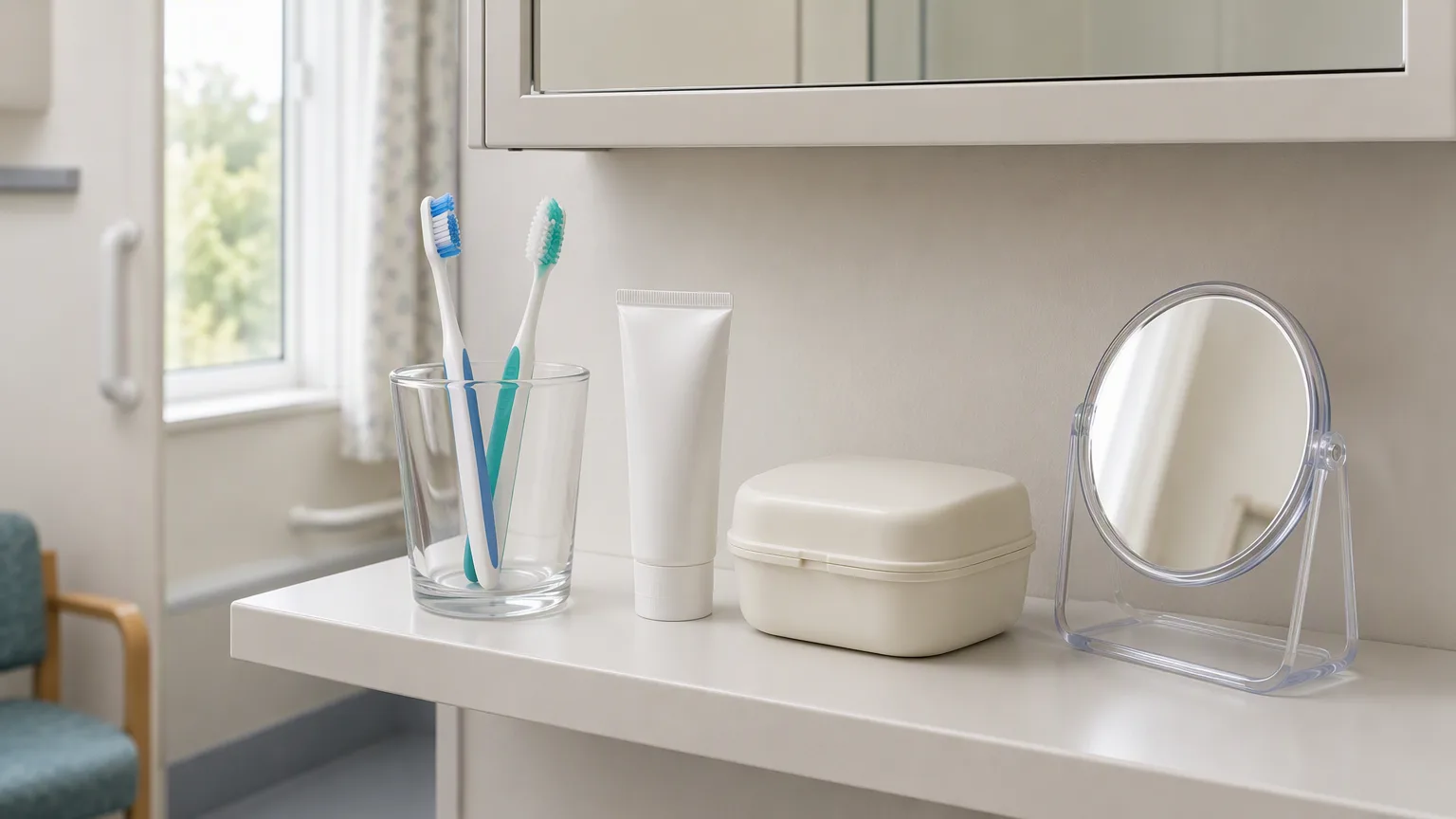
The equipment list the DH publishes for that routine is short and unglamorous: a toothbrush, fluoride toothpaste, a glass, water, a small basin, a towel or plastic sheet, disposable gloves, and glycerine with cotton buds for a resident whose lips are dry or cracked. It is worth reading that list next to the home's stock cupboard, because an oral care routine fails more often on the equipment than on the intention.
A dry mouth changes the arithmetic. The Elderly Health Service oral health page explains that saliva helps replace the minerals on the surface of a tooth, so a decrease in saliva secretion because of ageing or medication, along with frequent eating and drinking, increases the risk of dental caries. The DH oral care material for carers adds a smaller detail that decides comfort: where the creases running from the corners of the mouth are deep, they collect saliva or food, so the carer cleans and dries that area after meals so that it does not become inflamed.
Dentures: removing them, cleaning them and putting them back
Denture care is a nightly task with a technique attached. The DH oral care material describes it in sequence: in the evening, clean the dentures; when removing them, open the cheeks on both sides to create space in the mouth and rotate the denture so that a metal clasp or another part does not injure the soft tissue; clean every part with a cleansing liquid and a toothbrush; leave the dentures soaking in water overnight; and put them back the following morning.
The Elderly Health Service adds two prohibitions. Toothpaste should not be used on a removable denture, because the coarse particles may damage its parts. A denture should not be used to chew hard objects such as bone, crab shell or ice. For a fixed bridge, the service advises cleaning the bridge and the natural teeth together during normal brushing, and using special floss under the bridge every night so that plaque does not collect in the narrow space between the bridge and the gum.
One question is better asked on the day of admission than three years later. The guideline on oral health for adults in care homes published by the National Institute for Health and Care Excellence (NICE) asks care staff carrying out an admission assessment to find out whether a resident's dentures are marked or unmarked, and where they are unmarked, to ask whether the resident would like to arrange for marking and to offer help in doing so. It also asks for the name of the dentist or dental service the resident has used and how long ago they were last seen. A denture that carries no name is the item that goes missing in a shared bathroom.
When a resident has difficulty swallowing
The oral care routine changes for a resident who has trouble swallowing, cannot cooperate, or is not conscious. The DH material is explicit: do not use toothpaste; use the basic brushing method with a floss holder, an interdental brush or a single tuft brush; because these residents cannot rinse, wipe the teeth and the rest of the mouth clean after brushing; and where the resident has no teeth at all, a moist gauze is enough to wipe the mouth.
What does not change is who decides. Whether a swallowing difficulty needs assessment, and how food and drink should be prepared for that resident, is a professional judgement and not a care worker's call, which is the territory covered in dysphagia and mealtime safety. The carer's part stays the same in both settings: carry out the written routine, keep the mouth clean, and report what the mouth looks like to the nurse in charge.
What the care home itself has to record
Oral care is written into the licensing framework rather than left to a rota. Paragraph 12.4.1 of the Code of Practice for Residential Care Homes (Elderly Persons) requires a home to devise a personal care schedule and to provide personal care services such as bathing, hair cutting, nail cutting, dental and oral care, changing clothes and diapers, in a timely manner and whenever required, so that residents keep their body clean and comfortable and their skin dry. Dental and oral care sits in that list with the same standing as bathing.
The record follows the care. Paragraph 12.5 requires the home to maintain and update the Personal Health and Nursing Record of each resident, and dental and oral condition is one of the health condition assessments it names, alongside body weight, vital signs and activities of daily living. A home that has a daily routine but no assessment entry has a gap in the file rather than a gap in the care, and both are asked for differently.
The home is also expected to use outside services rather than to substitute for them. Paragraph 12.2.3 states that a home should provide assistance for visiting healthcare professionals, naming the Department of Health's Visiting Health Team and its Outreaching Dental Care service among them, in delivering the health service, dental checking or health education activities that residents need. That collaboration is where a care home's dental question usually belongs, and the medication list is part of it, because a dry mouth can follow from medication, as the medication management article sets out for the record side.
What is being cleaned, how often, and with what
The table below sets out the five common situations in a care home, the routine that each one needs, the equipment the published guidance names for it, and the source of that guidance. The last column is deliberately a named source rather than a house preference, because the routine should be traceable to something a manager can show.
| What is being cleaned | The daily routine | Equipment the source names | Source of the guidance |
|---|---|---|---|
| Natural teeth | Brushing in the morning and at night with a smaller amount of toothpaste, then cleaning between the teeth | Toothbrush, fluoride toothpaste, glass, water, basin, towel, disposable gloves, floss holder, interdental brush | Department of Health, oral care for frail elderly people |
| A removable denture | Cleaned at night, every part washed, soaked in water overnight, replaced in the morning | A brush, a cleansing liquid and a container of water; toothpaste is stated not to be suitable for a removable denture | Department of Health oral care material; Elderly Health Service oral health page |
| A dry mouth | Water through the day, fewer between meal snacks, and cleaning and drying the creases at the corners of the mouth after meals | A glass of water, a soft towel or cotton bud, and glycerine with cotton buds for cracked lips | Elderly Health Service oral health page; Department of Health oral care material |
| A resident who needs help | The carer sits in front, removes the dentures, checks the mouth, supports the head by holding the chin and does not force the brush in | Disposable gloves, towel or plastic sheet, toothbrush, gauze, and suction where the home has it | Department of Health, oral care for frail elderly people |
| A resident with swallowing difficulty | No toothpaste, basic brushing with interdental cleaning, and the mouth wiped clean afterwards because rinsing is not possible | Toothbrush, floss holder, single tuft brush, moist gauze | Department of Health, oral care for frail elderly people |
Two notes belong under that table. Where the mouth shows a wound or an abnormality, the guidance does not offer a home remedy; it directs the carer to a dentist. And where a resident has no teeth at all, the moist gauze in the last row is not a lesser version of brushing, it is the whole routine for that mouth.
The dental subsidy: what the Community Care Fund paid for, and what replaced it
The scheme most families knew was the Community Care Fund Elderly Dental Assistance Programme, delivered by the Hong Kong Dental Association with participating non governmental organisations and dental clinics. Its applicant notes describe what it funded: dentures and other dental treatment within the programme, including oral examination, scaling, fillings, extractions, X-ray examination, removal of a bridge or crown and root canal treatment. Two groups qualified. A person aged 65 or above who had received Old Age Living Allowance in the last three consecutive months was referred through a participating elderly centre, community centre or a dental clinic that accepted direct applications. A person aged 60 or above using Social Welfare Department home care services, and not receiving Comprehensive Social Security Assistance, was referred through the home care team. The applicant also had to have lost teeth and have difficulty eating or chewing or have dental disease, and had to be assessed by a participating dentist as needing and suitable for the treatment. The notes excluded anyone who had already used this programme or the Department of Health's Outreach Dental Care Programme, with a limited second service for a person aged 75 or above who had been treated five years or earlier.
The carer's role in it was administrative, and that part matters to a family. The form had to be completed in full and signed, once, because the notes warn that a duplicate application or a change of details after submission can delay the case. The older person attended a district service unit with the Hong Kong Identity Card, documents showing the allowance paid into a bank account for each of the last three consecutive months, and a document carrying the address. Where a person could not submit an application because of mental incapacity, a legal guardian appointed under the Mental Health Ordinance (Cap. 136) or a relative could call the project office on 2525 8198 to arrange special handling. The programme paid the non governmental organisation and the clinic directly rather than paying the applicant, and a participating dentist charged only the fee the project office released and could not ask the applicant for an extra amount; travelling costs were not covered. The list of participating dentists and clinics that was published alongside the scheme was dated, and it marked which clinics could not provide barrier free access, which is the detail that decides whether a resident using a wheelchair can attend at all.
That route is now closed to new applicants. The Government announced on 15 August 2025 that the programme would stop accepting applications with effect from 1 January 2026, that eligible elders had to submit through a service unit on or before 31 December 2025 and attend the first consultation no later than 31 January 2026, and that the Community Dental Support Programme under the Department of Health would supplant it, with its service scope expanded from 1 January 2026 to match what the fund had covered. The support programme is delivered with non governmental organisations, and eligibility turns on holding a Hong Kong Identity Card and being a beneficiary of Old Age Living Allowance, a participant in the Community Care Service Voucher Scheme at the specified co-payment category, a user of specified home care services, a holder of a Hospital Authority medical fee waiver, or a person certified and referred as homeless by a registered social worker, and on having joined the Electronic Health System (eHealth).
The cost sharing changed shape as well. Participants pay an administration fee or a co-payment to the organisation providing the service. For a participant in the three highest subsidy categories the Government subsidises the administration fee in full and a set of removable dentures carries a co-payment of HK$500, while a participant outside those categories pays an administration fee of HK$50 and HK$1,000 for a set. A set is an upper or a lower denture, and fitting both at the same time counts as one service. Denture fitting is available only to a person with fewer than 20 remaining teeth who is assessed by a dentist as having difficulty eating or chewing that dentures could effectively restore. Elderly Health Care Vouchers can be used to pay the administration or co-payment fees, and the programme hotline is 2111 3830.
The carer's checklist for the shift list and the file
An oral care routine survives a change of staff when the things that are easy to lose are written down. Six lines cover most of what a carer and a home need.
- The routine for this resident: which of the five situations in the table above applies, at what time of day it is carried out, and who carries it out.
- The mouth check before cleaning, and where the finding goes when there is one, including the name of the dentist or the dental service the home would contact.
- The state of the dentures: whether they are marked, whether they fit, and where the denture box is kept overnight.
- The assessment entry in the Personal Health and Nursing Record, with dental and oral condition recorded and reviewed with the rest of the health assessments.
- The medication list, because a dry mouth can follow from medication and the record is where that link is visible.
- The funding position: whether the resident has already used a subsidy, whether a dental appointment has been arranged, and who at the home owns the follow up.
Explore more
- SilverGuard Insights on aged care in Hong Kong : the wider archive on daily care, records and funding in residential care.
- Dysphagia and mealtime safety in a care home : the assessment and texture side that oral care sits beside.
- The Elderly Health Care Voucher Scheme : the vouchers that can be used to pay the dental programme fees.
- Medication management in a care home : the medication list that a dry mouth needs to be read against.
- Our FAQ : how monitoring and documentation questions are handled in practice.
- Steadicore : the sensing and risk-prediction platform in our own family of products.
Related notes
- Residential Care Home for the Elderly: Types and Subsidies
Residential care homes for the elderly in Hong Kong fall into four operating types and three care levels, and only some places are subsidised.
- Care Home Infection Control in Hong Kong
Care home infection control in Hong Kong: the written policy, hand hygiene moments, isolation, cleaning records, staff vaccination and outbreak reporting.
- Elderly Health Care Voucher Scheme: What It Pays For
The Elderly Health Care Voucher Scheme gives Hong Kong residents aged 65 or above $2,000 a year for private primary care, accumulating to an $8,000 limit.