
Dysphagia and Mealtime Safety in a Care Home
SilverGuard Technologies LimitedUpdated 8 min read
Dysphagia care home practice in Hong Kong starts with noticing, recording and referring: a speech therapist decides a resident's food texture and drink thickness after assessment, and the kitchen prepares to that level. The home's job is the mealtime process around it, from positioning and pace to oral care and the written record.
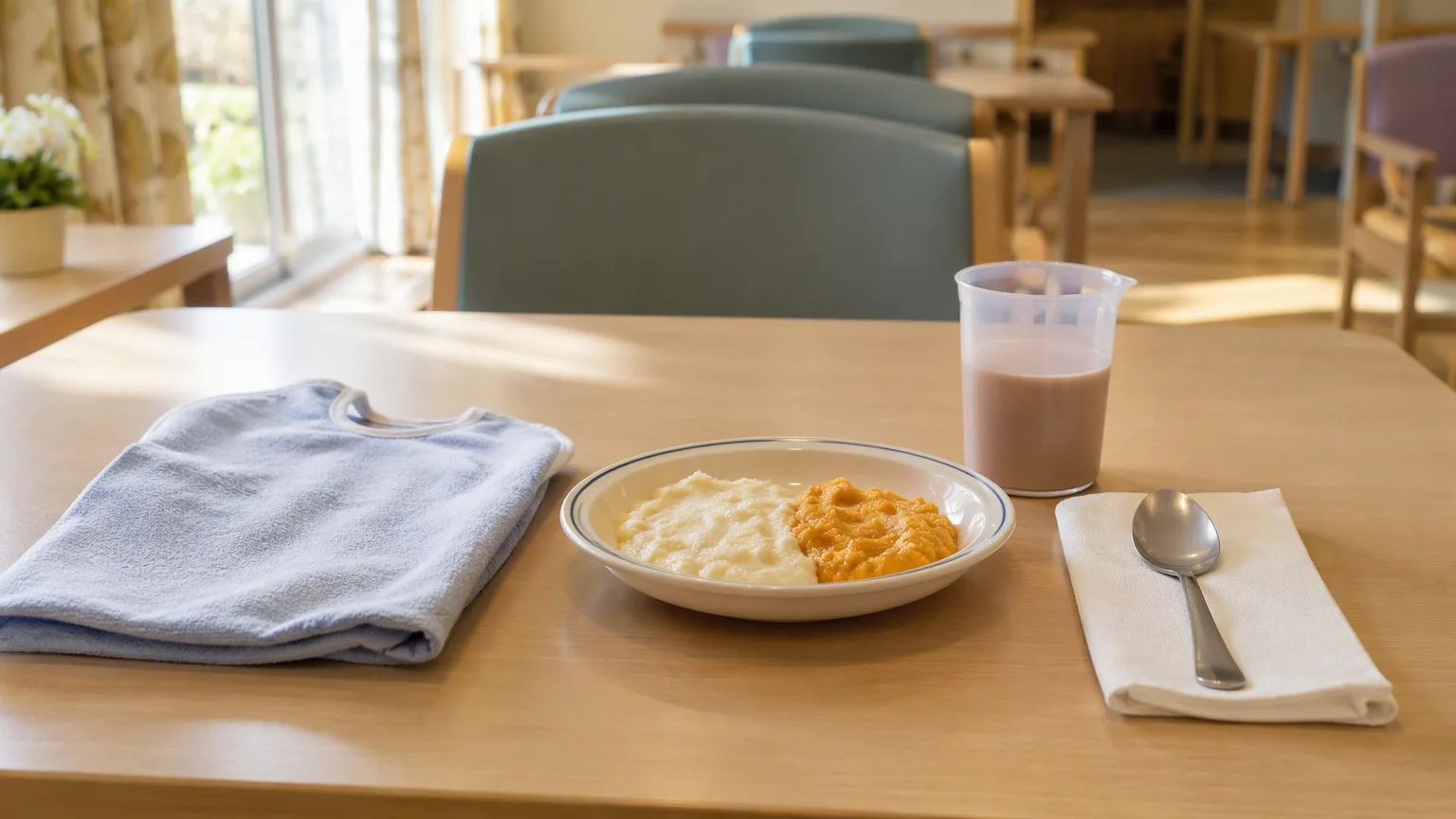
Why swallowing difficulty is a whole home process
Swallowing difficulty is common enough in Hong Kong care homes that a home without a process for it is relying on luck. Research by the University of Hong Kong's Swallowing Research Laboratory carried out between 2013 and 2015 interviewed 34 care homes and 21 subsidised day care units by telephone, and found that about six in ten care home residents and four in ten day care service users had swallowing difficulty of varying severity; of the 878 older people assessed in person, 43 per cent were found to have it. The research summary published by the University of Hong Kong also estimated that around 45,800 care home residents in Hong Kong had swallowing difficulty of some degree, and reported that during observation, 22 per cent of frontline care home staff were feeding more than one resident at the same time.
The department's caregiver guidance describes what is at stake without overstating it. Where swallowing is difficult, food cannot be safely and effectively carried from the mouth to the digestive tract, which affects the absorption of nutrition and fluid, and in severe cases can lead to choking or aspiration pneumonia. None of that is a judgement a care worker is asked to make. It is something a care worker is asked to notice, write down, hand over and escalate, which is the process this article describes.
The Elderly Health Service page on swallowing difficulty in older people lists the signs in the words a carer would use, and the list is what a shift should be watching for:
- Coughing or choking while eating or drinking.
- Having to swallow several times before food goes down.
- Waking at night because of coughing.
- Food coming back up into the nose.
- Food left behind in the mouth, so that the mouth smells stale.
- Drooling caused by weakened control of the mouth muscles.
- A change in eating habits, such as eating more congee or softer food, or adding soup or water to rice.
- A feeling that food is stuck in the throat, neither going up nor going down.
- Food flowing back up after swallowing.
What the department says to do about the signs
The same page lists what it calls the more serious consequences: aspiration pneumonia, obstruction of the airway and suffocation, and malnutrition and dehydration, showing as weight loss and dry skin. What it tells the reader to do about all of this is one short instruction: older people can have swallowing problems of different degrees, so the older person should be assessed by healthcare professionals and given advice, and where coughing or choking during meals happens often, medical attention should be sought promptly. In a care home, the practical translation of that instruction is a referral and a record, not a decision taken in the dining room.
The page also groups the risk factors, which is useful when a home reviews its dining room: chronic illness, particularly neurological conditions such as stroke, Parkinson's disease and dementia; eating too quickly; weakened chewing or swallowing ability, including bad teeth or ill fitting dentures; food that is too firm, hard, large, slippery, tough or sticky; an incorrect sitting posture, such as eating while lying down; and eating while distracted.
Who decides the texture, and why it is not the kitchen
The decision belongs to a clinician, and the international standard says so in one sentence. The IDDSI framework page of the International Dysphagia Diet Standardisation Initiative states that the clinician has the responsibility to make recommendations for foods or drinks for a particular patient based on their comprehensive clinical assessment.
The local Code of Practice for Residential Care Homes (Elderly Persons) is built on the same assumption. Paragraph 14.3.1 of the Code of Practice requires a home to learn residents' eating habits and preferences, to assess their feeding ability and dietary needs on admission and review those assessments regularly, to seek advice from healthcare professionals in designing the menu and providing appropriate meals to residents with chewing or swallowing difficulties, and to review residents' swallowing and eating condition regularly.
The department's catering guide for care homes draws the line even more plainly. The Guide on Menu Planning for Residential Care Homes for the Elderly, revised in December 2023, states that residents with swallowing difficulty may each be able to take a different food texture and a different thickness of fluid, and that the match can only be made after individual assessment by healthcare professionals, with healthcare professionals consulted early where a resident's eating problem persists or worsens. That one sentence is the whole rule: the kitchen cooks to a level, and the level comes from an assessment.
One related point belongs here, because it is the one a kitchen is most tempted to settle on its own. The Elderly Health Service states that an older person with swallowing difficulty should use a thickening product according to the instructions of a doctor or a speech therapist. The instruction is individual to that resident and it is written down. Without both, a meal service is guessing, and a texture level carried across from one resident to another is not an assessment.
The two frameworks a Hong Kong home meets
Two sets of labels reach the same plate. The international one is the IDDSI Framework, a continuum of eight levels numbered 0 to 7, with drinks measured from levels 0 to 4 and foods measured from levels 3 to 7, which gives clinicians, care staff and food service one vocabulary for food texture and drink thickness. The same standard states that its tests confirm the characteristics of a food or drink at the time of testing, that testing should be done under the intended serving conditions and especially at the intended temperature, and that the recommendation for a particular person comes from the clinician.
The local one is the Care Food Standard Guideline published by the Hong Kong Council of Social Service, developed with the Food Research Centre of the Chinese University of Hong Kong and the Swallowing Research Laboratory of the University of Hong Kong, and announced in a council press release dated 9 May 2023. It uses the IDDSI framework as its basis and adds local naming, local ingredients and cooking guidance, and it arranges food and drink states into nine levels, with thin liquid at level 0, finely chopped and moist food at level 5, and whole normal food at level 7. Its simple version can be applied with a fork, a spoon or a syringe, which is what makes the guideline usable in a care home kitchen rather than only in a clinic.
The table below sets out the IDDSI levels in the terms a care home meets them. The level names and the descriptions are those in the IDDSI Framework and Detailed Level Definitions, version 2.2 (2026), and the standard itself adds the warning that descriptions alone never settle a level, because the tests are what confirm it.
| IDDSI level | What the food or drink looks like | Who sets that level for a resident |
|---|---|---|
| Level 0, thin | A drink that flows like water, and flows fast | The speech therapist, in that resident's written assessment |
| Level 1, slightly thick | A drink thicker than water that still flows through a straw or a syringe | The speech therapist, in that resident's written assessment |
| Level 2, mildly thick | A drink that pours off a spoon, but more slowly than thin liquid | The speech therapist, in that resident's written assessment |
| Level 3, moderately thick for drinks and liquidised for food | A drink that can be taken from a cup, and food that cannot be piped or moulded because it will not hold its shape | The speech therapist, in that resident's written assessment |
| Level 4, extremely thick for drinks and pureed for food | Food usually taken with a spoon that holds its shape on the plate and needs no chewing | The speech therapist, in that resident's written assessment |
| Level 5, minced and moist | Moist, soft food with small lumps visible that are easy to squash, and no separate thin liquid | The speech therapist, in that resident's written assessment |
| Level 6, soft and bite sized | Soft, tender food cut into pieces no larger than about 1.5 cm, soft enough to be broken down under pressure from a fork | The speech therapist, in that resident's written assessment |
| Level 7, easy to chew or regular | Everyday food that is soft and tender, or at regular, everyday food of various textures, which may be hard and crunchy | The speech therapist, in that resident's written assessment |
Two details in the standard matter for a care home. First, level 7 carries two quite different diets, because easy to chew means everyday food that is soft and tender while regular carries no texture restriction at all, including hard, crunchy, crumbly and mixed textures. Second, the framework has a separate group for transitional foods, which start firm and change texture when moisture or heat is applied, and the standard uses that group only where a clinician has assessed it as suitable. A home that treats all three as one level has flattened the framework at the point where the difference matters most.
The meal itself: menu, plate and the foods that carry risk
The menu is a controlled document rather than an improvisation. Paragraph 14.2 of the Code of Practice requires a home to design a menu covering a period of at least two weeks in advance and display it in a prominent place, to provide special diets such as vegetarian, low fat, low sugar, low salt, minced food, pureed food and soft diet having regard to residents' personal needs including health conditions and other risk factors such as swallowing difficulty and cognitive ability, to design a separate special diet menu for the staff who prepare food and arrange meals, and to update the menu immediately when a resident's special dietary needs change.
The plate is governed by the same chapter. Paragraph 14.4.2 sets the easy to chew principle: food of an appropriate consistency, texture and size, finely chopped and tenderly cooked vegetables and meat, and no bony fish or meat. Paragraph 14.4 requires at least three meals a day, with the timing of each meal spaced at appropriate intervals and drinks and snacks in between depending on the individual resident's need.
Paragraph 14.5.5 names the foods a home should not serve: food that is too sticky, such as glutinous rice, glutinous rice dumplings and Chinese New Year cake; food that is too crumbly, such as egg rolls and shortbread; and food that is hard in texture, such as peanuts and walnuts. The Elderly Health Service caregiver guidance lists the same groups and gives the reason, adding food that is difficult to chew, food with a high viscosity that can be compressed, food that breaks apart easily on entering the mouth, and mixed textures such as rice or noodles served with soup, where different textures move down the throat at different speeds.
The IDDSI standard extends the list with the textures it identifies as choking risks, drawn from international autopsy reports: hard or dry textures such as nuts and raw carrot; fibrous or tough textures such as steak and pineapple; chewy and sticky textures such as sweets, sticky rice cakes and konjac jelly; crumbly textures such as dry cake and dry biscuits; round or long shaped foods such as sausages and grapes; mixed thin and thick textures such as soup with food pieces, cereal with milk or bubble tea; stringy, floppy and juicy textures; and food containing bones, pips, seeds, skins or husks.
One route into the dining room sits outside the kitchen's control. Paragraph 14.6.3 requires a home to explain to family members and visitors the points to note about food brought in, to advise them of the individual resident's risks in eating, and to ask them to check with the nurse or health worker on duty first so that it can be decided whether that food is suitable for that resident.
Positioning, pace and the dining room
Most of what protects a resident at a meal is not equipment. The department's feeding guidance for carers sets out the sequence a care worker can follow, and it is written for a care home as much as for a family. The dining area should be well ventilated and adequately lit, the television should be off so that the person can concentrate, and there should be enough time to eat. The resident should sit up straight at a table of appropriate height, with dentures, glasses and hearing aids in place where they are used.
Utensils and pace are part of the same instruction. Smaller spoons help to control how much food goes in at once, and the guidance suggests asking an occupational therapist about adapted cutlery, cups and bowls rather than choosing them at random. The person should be fed only after the previous mouthful has been chewed and swallowed, not too much at a time and not too fast. A head tipped slightly downward, which positions the lower jaw down, reduces the chance of choking, and the guidance asks carers to keep the person's attention on the meal rather than on conversation or a screen, and to pause and allow the person to cough food out if coughing starts.
The Code of Practice places the same requirements on the home. Paragraph 14.6.1 requires staff to monitor residents' eating conditions including at snack times, to serve meals in a place with adequate lighting and ventilation, to give sufficient meal time so that residents eat without feeling hurried, to provide appropriate eating utensils and assistive devices, and to provide assistance and prompts as appropriate. Paragraph 14.6.2 requires staff with relevant training to feed or assist residents who need it, to do so according to healthcare professionals' recommendations, to ensure that residents sit up straight as far as possible, to feed at a reasonable pace that ensures the food has been swallowed, and to avoid letting residents lie down immediately after meals. Paragraph 15.3 also expects hand hygiene before preparing food or feeding.
The choking response, and why it has to be in writing
The distance between an awkward meal and an emergency is short. The department's feeding guidance for carers lists the signs and symptoms of choking or aspiration as continuous coughing; being unable to speak or having difficulty breathing; hands clutched around the neck with signs of distress; skin, fingernails or lips turning blue; and, in severe cases, loss of consciousness. Its instruction to the carer is to keep calm, to handle the situation promptly, and to send the person to the Accident and Emergency Department as necessary.
What a home should be able to show is not a memorised sentence but a written procedure. Paragraph 12.2.6 of the Code of Practice requires an RCHE to have contingency arrangements in place at all times for emergencies and accidents, including work guidelines that cover the kinds of emergency, the ways of immediate handling, and the list of emergency contact numbers.
This article deliberately stops there. First aid technique and any decision about a resident's airway belong to trained staff and to the clinical team, and the sequence of a choking response is a matter for the home's own written procedure and for the training its staff have completed. Nothing written here substitutes for that training, and nothing written here substitutes for the professional assessment that set the resident's texture level.
After the meal, and the half hour that matters
The meal is not over when the plate is empty. The department's feeding guidance sets out the after care: check the resident's mouth for food debris so that nothing is left there to be aspirated, help the resident to rinse the mouth, clean the dentures or carry out oral care, and wipe the mouth if necessary. It adds one instruction worth putting on the wall of a dining room: do not let the resident lie down straight after the meal, but remain seated in an upright position for at least 30 minutes. For residents who are particularly frail, staff should observe their mental state after the meal and watch for signs of aspiration or choking.
Oral care before the meal belongs to the same routine, because the guidance asks carers to rinse the mouth before meals to stimulate appetite. The daily habits and denture handling are set out in oral health care for older adults.
The record, the handover and where the assessment comes from
The meal is also a record. Paragraph 14.3.3 of the Code requires a home, subject to individual residents' special needs, to keep records of their food and fluid intake so that dietary needs can be monitored. Paragraph 14.3.2 requires regular weighing with the records kept, and states that a weight loss of more than 5 per cent within a month, or more than 10 per cent within six months, suggests likely signs of malnutrition, at which point the home should seek advice from healthcare professionals and arrange medical treatment for the resident.
The resident's care plan is where the texture level belongs. Paragraph 12.3.3 requires the Individual Care Plan to include an assessment of risk factors and the preventive measures for them, and names swallowing difficulty among the examples alongside falls, wandering and cognitive impairment. Paragraph 12.3.2 sets the timetable: the plan is formulated with the resident and the family within one month of admission, reviewed for the first time six months later, and then reviewed at least annually or whenever the care required changes. Paragraph 12.4.4 expects signs near the bedside, or in another suitable place, that identify a resident's special nursing care needs or risk factors such as allergies, falls and swallowing difficulty.
The handover has a home in the Code as well. Paragraph 8.7.2(i) requires the log book to be used by the staff on duty to record daily events including irregularities observed on individual residents, emergencies and follow up actions after an accident, signed properly by the staff concerned and submitted regularly to the home manager, with the log book kept in the home for inspection. At mealtimes that is where a cough at lunch, a refusal to eat, a changed texture instruction and a new referral all become visible to the next shift. Paragraph 12.4.5 supports it by requiring staff to receive training and supervision related to personal care and nursing care skills such as feeding, and to consult the relevant guidelines and healthcare professionals' advice.
Where the assessment itself comes from has a short answer. The department's caregiver guidance states that an older person with swallowing difficulty should be assessed by healthcare professionals and given advice, that frequent coughing or choking during meals calls for prompt medical attention, and that the texture of the meal served should follow the recommendations of medical staff, dietitians and speech therapists. Whatever comes back, the home's part is unchanged: cook to the level in the written instruction, record the meal, hand it over at the end of the shift, and review the plan when the resident's condition changes. Nothing in this article is medical advice, and no article can set a texture level for a resident.
Explore more
- SilverGuard Insights on aged care : our other notes on care home operations, records and monitoring.
- Medication management in a care home : the other routine where a written instruction decides what a resident receives.
- Oral health care for older adults : the daily mouth care that keeps mealtimes safer.
- Care home staffing ratios in Hong Kong : how many staff a dining room needs at 1 pm, and what the staffing table requires.
- Our FAQ : deployment, alerting and privacy questions we are asked most often.
- Steadicore : our sister brand for stability and mobility products.
Related notes
- Residential Care Home for the Elderly: Types and Subsidies
Residential care homes for the elderly in Hong Kong fall into four operating types and three care levels, and only some places are subsidised.
- Care Home Inspection Preparation in Hong Kong
Preparation for a care home inspection in Hong Kong: the licence, the Code of Practice records an inspection asks for, and the certificates behind them.
- Care home staffing ratio in Hong Kong: what the Code sets
Hong Kong care home staffing ratio: the minimum headcount the Code of Practice sets, by staff grade, home type and shift, including the night requirement.