
The aged care AI platform for fall risk — without a single wearable.
Predict instability before it becomes a fall.
Steadicore turns ordinary phones, tablets, laptops, or facility cameras into a closed-loop assessment, prediction, intervention, and proof system for fall prevention.
- 60-day paid pilot available
- Apple Silicon & Edge-ready
- Works on existing devices
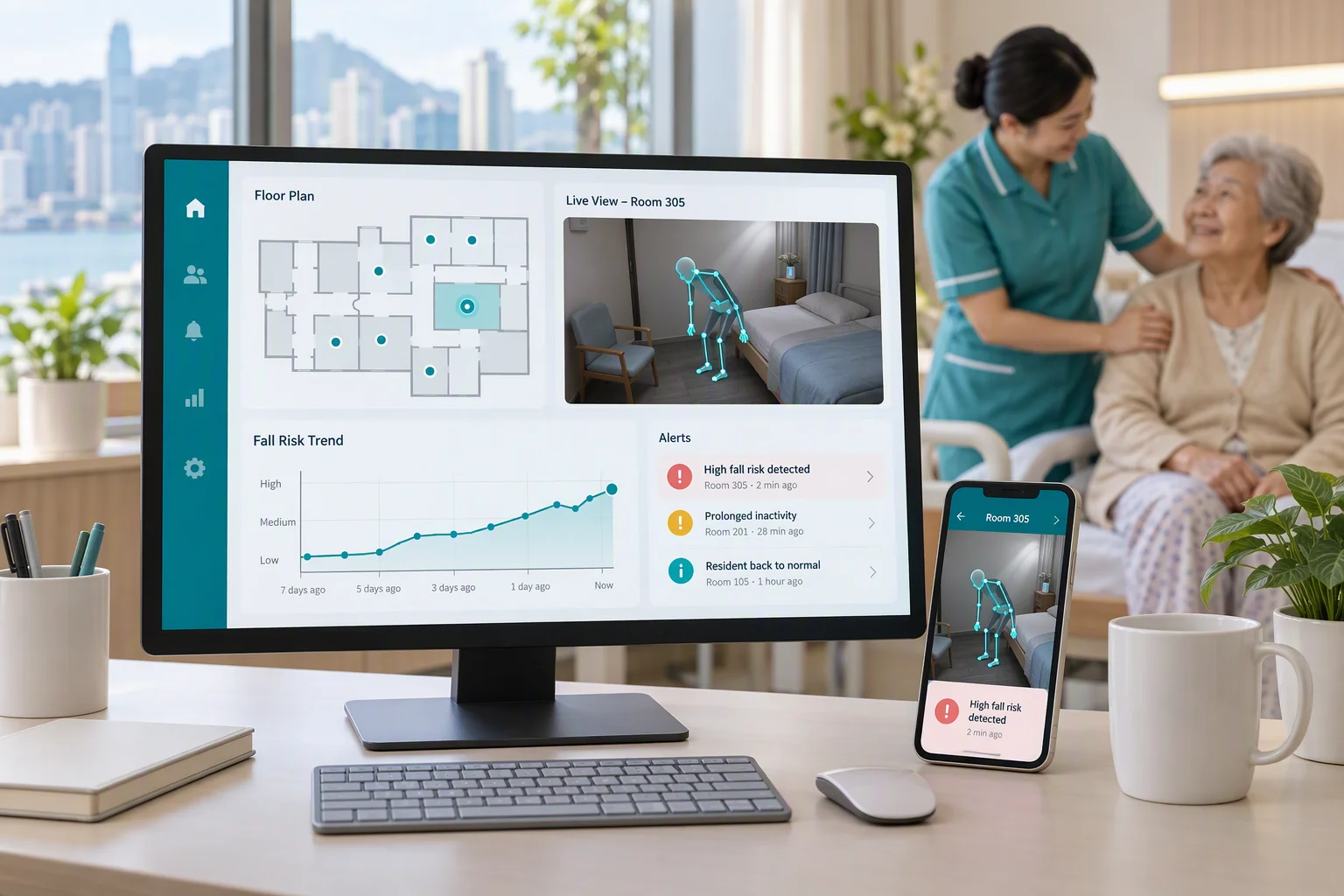
Built for three audiences, one loop.
Care homes & RCHEs
Reduce falls, differentiate care, prove outcomes to families and regulators — on your existing tablets.
Rehab teams & physiotherapists
Extend therapist reach with precision assessment, dual-task interventions, and longitudinal evidence.
Families at home
Protect aging parents with short guided assessments and adaptive home exercise — no installation.
Fall prevention today is fragmented, reactive, and hard to prove.
- Static risk scores don't tell caregivers what to do next.
- Exercise libraries don't adapt to the resident's real instability pattern.
- Monitoring alerts arrive after the fall, not before.
- Hardware-heavy solutions stall in procurement for months.
One closed loop: Assess → Predict → Personalize → Reassess → Prove.
Multimodal Assessment Engine
Short guided flows (sit-to-stand, turning, balance hold, walk-turn-sit, voice prompts, dual-task) extract digital biomarkers across movement, voice, and cognition.
Counterfactual Risk Engine
We go beyond a single risk score to simulate how instability evolves under fatigue, distraction, slower reaction, or narrower margins — ranked instability pathways and a Recovery Margin.
Adaptive Intervention Engine
Risk-conditioned, dual-task micro-interventions with dynamic difficulty, progressive overload, and compensation/fatigue detection — not generic exercise videos.
Progress Intelligence Layer
Role-based reports for elders, caregivers, and clinicians. Trend lines on sit-to-stand quality, balance stability, dual-task cost, reaction time, asymmetry, and predicted recovery margin.
The full-stack prevention platform.
No wearables, no sensors
Runs on any camera + microphone. Phone, tablet, laptop, or facility-owned device.
Dual-task cognitive-motor library
Sit-to-stand with verbal fluency, balance with number sequencing, stepping with reaction inhibition, marching with working memory.
Cohort analytics for operators
See who is stabilizing, plateauing, or deteriorating across your home or program.
Exportable PDF & CSV reports
Designed for operator reviews, therapist handoffs, and future EMR/API integration.
Privacy-first architecture
Minimal raw-media retention, role-based access, audit logs, privacy-by-design.
Hong Kong-ready
Built for RCHE workflows, trilingual (EN / 繁 / 简), and aligned with Hong Kong care realities.
From a 5-minute assessment to a measurable trajectory.
- 1
Guided assessment
A resident or family member runs a short flow on a tablet or phone — sit-to-stand, turning, balance, voice, dual-task.
- 2
Risk & pathways
The Counterfactual Risk Engine estimates instability under multiple what-if scenarios and computes a Recovery Margin.
- 3
Adaptive plan
The Adaptive Intervention Engine generates a personalized, dual-task micro-program dosed to the resident's readiness.
- 4
Prove progress
Role-based progress reports show improvement trends, adherence, and predicted margin shifts to elders, caregivers, and clinicians.
The only full-stack fall prevention platform.
Competitors do one layer. Steadicore combines all four.
| Features | Steadicore | Typical competitor |
|---|---|---|
| Pure software (no proprietary wearable) | Included | Partial |
| Counterfactual "what-if" risk simulation | Included | Not included |
| Adaptive SI-motion micro-interventions | Included | Partial |
| Cognitive-motor dual-task design | Included | Partial |
| Role-based reports (elder / caregiver / clinician) | Included | Partial |
| Multimodal (movement + voice + context) | Included | Not included |
Further reading
The published notes that go with this product — written for the same operational questions, with the sources shown.
- Locked Door Policy in a Care Home
A locked door policy for a care home: what the Code of Practice asks for, who holds a key on each shift, the alternatives to try first, and what to record.
- Bed Exit Alarms in Care Homes: Choosing and Using Them
How bed exit alarms in care homes work, how pressure pads, infrared and wearables compare, where each fits, and why alarms support rather than replace staff.
- Fall Prevention in Care Homes
A practical fall prevention checklist for residential care homes, covering risk factors, the environment, staff routines and where monitoring technology fits.
- Fall Risk Assessment for Care Homes
How to run a fall risk assessment in a care home: what to record, how often to repeat it, how to escalate a change, and where the record belongs.
Ready to prevent falls, not just detect them?
Book a 20-minute demo or start a 60-day pilot. We'll show you live assessments on a tablet.