
Camera Fall Detection: What It Sees and Misses
SilverGuard Technologies Limited9 min read
Camera fall detection reads the video a care home already records, estimates body pose frame by frame, and flags a fall-like pattern — a fast drop, a body staying on the floor — so staff can verify. It is not a medical device, it does not diagnose injury, and it cannot see through a closed bathroom door.
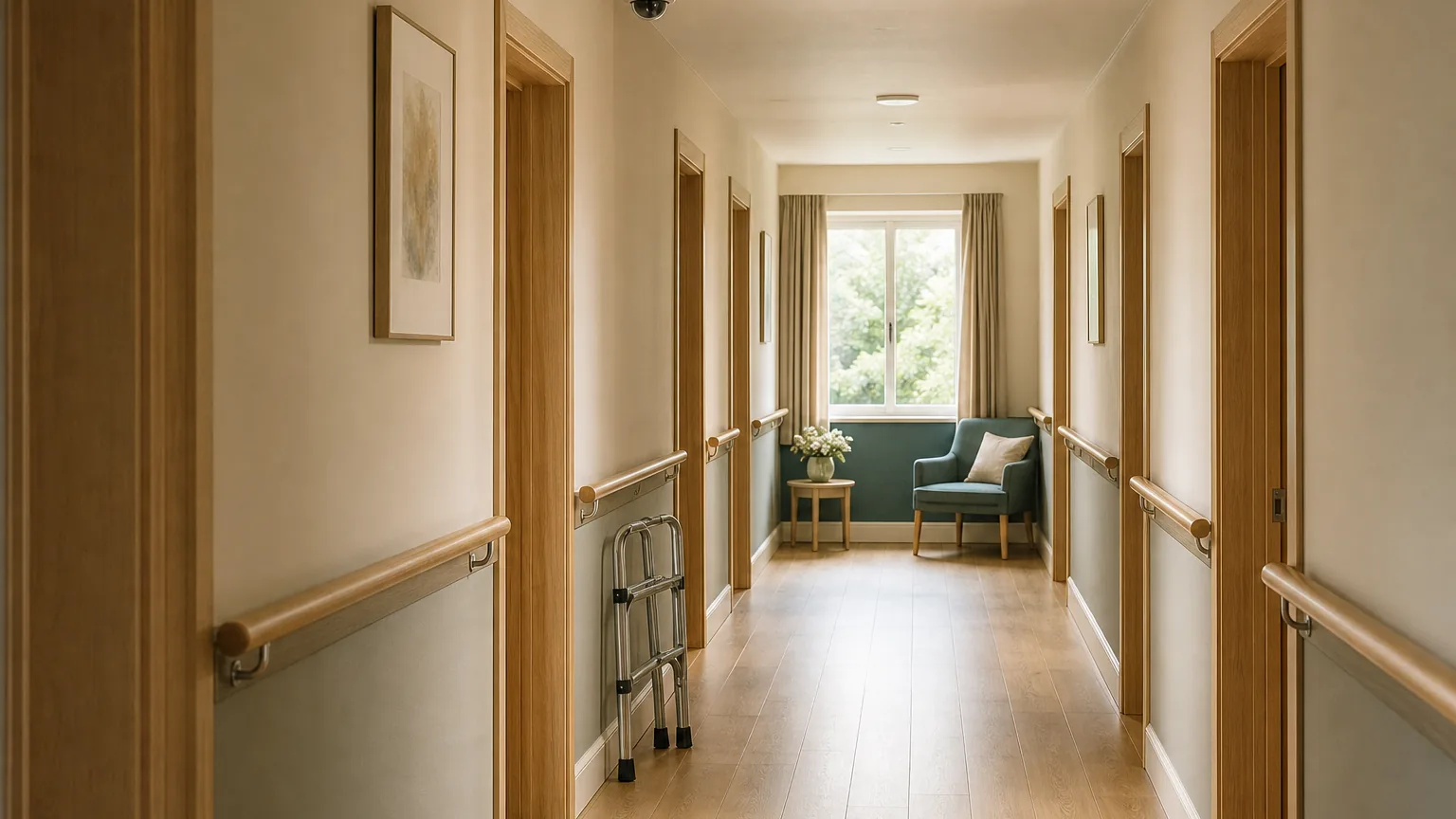
How camera fall detection actually works
A camera-based system does not look for a person falling. It looks for a shape that stops behaving like a standing person. Each frame is passed through a pose model that returns a skeleton — shoulders, hips, knees, ankles — and a second model watches that skeleton over a window of a few seconds. A rapid vertical collapse followed by a horizontal, motionless skeleton is the pattern that triggers an alert. That two-stage design is why the same camera can also report a resident who has slipped off a chair and stayed on the floor, which a movement-only alarm would miss.
The processing matters as much as the model. On an edge device, the video is decoded inside the home and only the skeleton coordinates and a short event clip leave the box; on a cloud design, frames are uploaded and the home is trusting a vendor's data handling instead. Ask which one you are buying, because it decides most of the privacy answer in section four. We describe the edge design on the Steadicore page rather than in the abstract.
One honest limit sits at the front of the pipeline. A pose model needs to see a body. A resident under a duvet, behind a drawn curtain, in a room lit only by a night light, or half-hidden by an overbed table is a body the model may not resolve, and an unresolved body produces no alert rather than a false one. That is the failure mode a vendor demo never shows, and it is the first question to ask: what does the system do when it cannot see?
A fall-detection camera compared with the other detectors
A camera is one of four ways to notice a fall in a care home, and each fails differently. The table compares them on the question that matters — what happens in the minute after the fall — rather than on sensor specification.
| Detector | What it notices | Where it works | Where it fails | Staff effort after an alert |
|---|---|---|---|---|
| Ceiling camera with pose estimation | A fall-like pattern anywhere in the camera's field | Corridors, day rooms, bedrooms with a clear view of the floor | Bathrooms, curtained beds, heavy occlusion, very low light | One person walks to the room to verify |
| Wearable pendant or watch | A sharp impact and a change of posture | Anywhere the device is worn | Not worn, not charged, in the shower, left on the bedside table | Same, plus the resident must press or not cancel |
| Bed or chair sensor mat | Leaving the bed or chair, and weight off the mat | The bed and the chair it is fitted to | The bathroom, the corridor, a fall while walking | Same, triggered earlier — on exit rather than on the floor |
| Scheduled staff rounds | Whatever is visible at the moment of the round | Everywhere, at the interval chosen | The 40 minutes between two rounds | None until the next round |
Read down the third column and the reason a home ends up with more than one detector is obvious: no single row covers the building. The camera row covers the most floor area per unit of staff attention, and it covers the rooms where a resident is alone. The mat row covers the transition a camera sees late. The wearable covers the resident who walks to the toilet at 3 a.m. and is out of every camera's view.
This is also why the phrase "fall-detection camera" is narrower than buyers expect. It describes a camera with a model attached, not a complete fall response. The comparison of a fall detection sensor with a personal alarm sets out the same distinction for the wearable side of the market.
What the camera cannot see, and why that is the whole conversation
Three failure classes repeat in every deployment. The first is occlusion: a body behind furniture, under bedding, or in the narrow band between the camera's cone and the wall. The second is lighting: most care-home cameras are chosen for identification at the door, not for pose estimation at 2 a.m., and a dark room with one warm lamp is a hard input. The third is the ambiguous event — a resident lowering themselves to the floor deliberately, a resident kneeling to pick something up, two residents helping each other. These produce a fall-like pattern and a correct alert that turns out not to be a fall.
False alerts are not a bug to be eliminated; they are the price of sensitivity, and the number the home should ask for is not the accuracy figure on a brochure but the alerts per bed per night at the sensitivity the home will actually run. A system tuned so tightly that it never cries wolf will also miss the slow slide off the bed that is the most common serious event in a room with a low bed and a frail resident.
The related problem is the slow fall. A collapse from standing is easy. A resident who grips the bed rail, slides down it over fifteen seconds and ends up sitting on the floor is a pattern that looks like sitting down, and it is exactly the event that leaves someone on the floor for an hour. Test the product against that, not against a volunteer dropping onto a mat.
Privacy, the PDPO, and the care home Code of Practice
A camera in a bedroom is personal data collection under the Personal Data (Privacy) Ordinance (Cap. 486), and the care home is the data user even when a vendor runs the model. That has practical consequences: residents and families should be told what is collected, why, who can see it, and how long it is kept; access should be limited to staff who need it; and footage should not be repurposed for performance monitoring of staff without a separate justification.
The Code of Practice for Residential Care Homes (Elderly Persons) now deals with CCTV directly. Chapter 7, as amended in June 2026, requires recording, retention of at least 30 days of footage, repair within 7 working days, and a written policy and mechanism for monitoring and reviewing recordings. A home that installs a fall detection layer on top of that CCTV inherits the obligation, and gains a question it must answer in its own policy: is the detection output a record, and if so who reviews it? We set out the chapter structure in the Code of Practice note.
The design choice that resolves most of this is to process on the device and keep no identifiable video. Pose estimation does not need a face, and a system that recognises faces adds a biometric capability the home did not ask for and would have to justify. Privacy-preserving vision in aged care covers the technical side of that trade in more detail.
The response protocol is part of the product
An alert that arrives on a phone nobody is carrying is worse than no alert, because it converts a safety system into a false assurance. Before the first camera is mounted, the home needs to answer four questions in writing: which device receives the alert, who is expected to attend, how long they have before escalation, and what gets recorded afterwards. A ten-minute escalation to a second person is not bureaucracy; it is the difference between an alert and a response.
The record matters as much as the response. Every alert should leave a timestamp, the room, the staff member who attended, the time attended, and the outcome — a fall, a near miss, or a false alert. That log is what turns a monitoring system into evidence, and it is the same record a home needs when an incident is reviewed later. It also gives the home the only honest way to tune sensitivity: raise it until false alerts become a nuisance, then step back one notch and read the log again.
Where the home has a night shift of one or two people, the protocol has to assume that the person receiving the alert may be the person who must attend. That is a staffing fact, not a technology one, and no camera changes it. The arithmetic of a night shift is set out in the care home staffing ratio note.
Choosing a system, and what to ask before you sign
A short list of questions separates a working deployment from a demonstration. Ask for the alerts per bed per night at the sensitivity you will run, not the accuracy percentage. Ask what the system does when the body is not resolvable — silence, or an alert saying the camera cannot see. Ask whether the model runs on the device or in a vendor's cloud, and where the data sits. Ask whether the output can be exported into the home's incident record, because a monitoring system that cannot feed the incident log adds a second place to look.
Then ask about the rooms the camera cannot cover. A corridor camera covers the walk to the bathroom and the moment a resident goes down in the corridor. It does not cover the bathroom itself, and that room is where a large share of falls happen. Bathroom fall detection deals with what to do there, because the answer is a mix of hardware, design and staff practice rather than another camera.
Steadicore is the monitoring system SilverGuard builds: it turns existing cameras into a contactless layer that flags fall-like patterns and leaves a timestamped record, and it requires staff verification of every alert. It is not a medical device and it does not replace a round. What it changes is the interval between the fall and someone knowing about it, and that interval is the part of a fall a building can actually influence.
Frequently asked questions
- Does camera fall detection work in the dark?
- It depends on the camera, not the model. Pose estimation needs a usable image, so a camera with infrared illumination in a room with no light can still return a skeleton, while a colour camera in the same room returns noise. Ask for a night-time demonstration in the actual room, with the actual bedding, at the hour the home is most worried about.
- Is a camera fall detection system a medical device?
- No. It is a monitoring system that flags a pattern for staff to verify. It does not diagnose a fracture, a stroke or a head injury, and its output is not a clinical finding. The clinical judgement stays with the nurse or the doctor who attends.
- How many cameras does a care home need?
- It depends on the building, not on a rule of thumb. The number follows from the rooms the home decides to cover — corridors, day rooms, and the bedrooms where a resident is alone — and from each camera's field of view at the height it can actually be mounted. A vendor who quotes a number before walking the building is guessing.
- Can the footage be used to check on staff?
- Not without a separate justification. Using a camera installed for resident safety to monitor employee performance is a different purpose under the Personal Data (Privacy) Ordinance, and the home's CCTV policy should say which purposes are permitted and who may review recordings.
Explore more
- Steadicore, the fall-sensing layer : how the camera layer is described on its own page.
- Fall prediction and fall detection for care homes : the system-level view, before choosing a detector.
- Privacy-preserving vision in aged care : on-device processing, and what a camera does not need to keep.
- Bathroom fall detection : the one room a camera cannot be the answer to.
- The care home Code of Practice in Hong Kong : including the CCTV requirements added in June 2026.
- SilverGuard Insights : our other notes on running a Hong Kong care home.
- Steadicore : the monitoring system this note is about.
- Easikin : for the family side of the same week.
The product behind this note
CCTV sensing + SI (Superintelligence) · AI (artificial intelligence) risk prediction for aged care
Turns existing care-home CCTV cameras into a 24/7 contactless safety layer. Pose estimation spots fall-like patterns with no facial recognition, no raw video, and no wearables, so staff are alerted early.
Hong Kong aged-care tech watch
When a subsidy, a policy or a care-home rule changes, you get one clear note.
We read the HK policy papers, subsidy circulars and care-home notices, then send one short note when something actually changes: what changed, who it affects, and what to do next. No fixed schedule — if nothing moves, you hear nothing.
Related notes
- Fall Prediction and Fall Detection for Care Homes
How to choose a fall detection system for a care home, and how fall prediction differs from detection: camera, radar and wearable options, and the vendor questions.
- Privacy-Preserving Vision in Aged Care
What privacy-preserving vision means in a care home: on-device processing, skeletal rather than facial detection, retention and the questions families ask.
- Fall Detection in the Bathroom: The Room Cameras Miss
Fall detection in a care home bathroom: why a camera cannot go there, which sensors and design measures do work, and how staff practice covers the rest.