
Fall Detection in the Bathroom: The Room Cameras Miss
SilverGuard Technologies Limited9 min read
Fall detection in a bathroom means noticing a fall in a room where no camera can be installed. In practice it is a combination: a door or occupancy sensor, a floor mat that reads weight, grab rails and a shower seat that reduce the fall, and a staff check interval short enough that a closed door is opened.
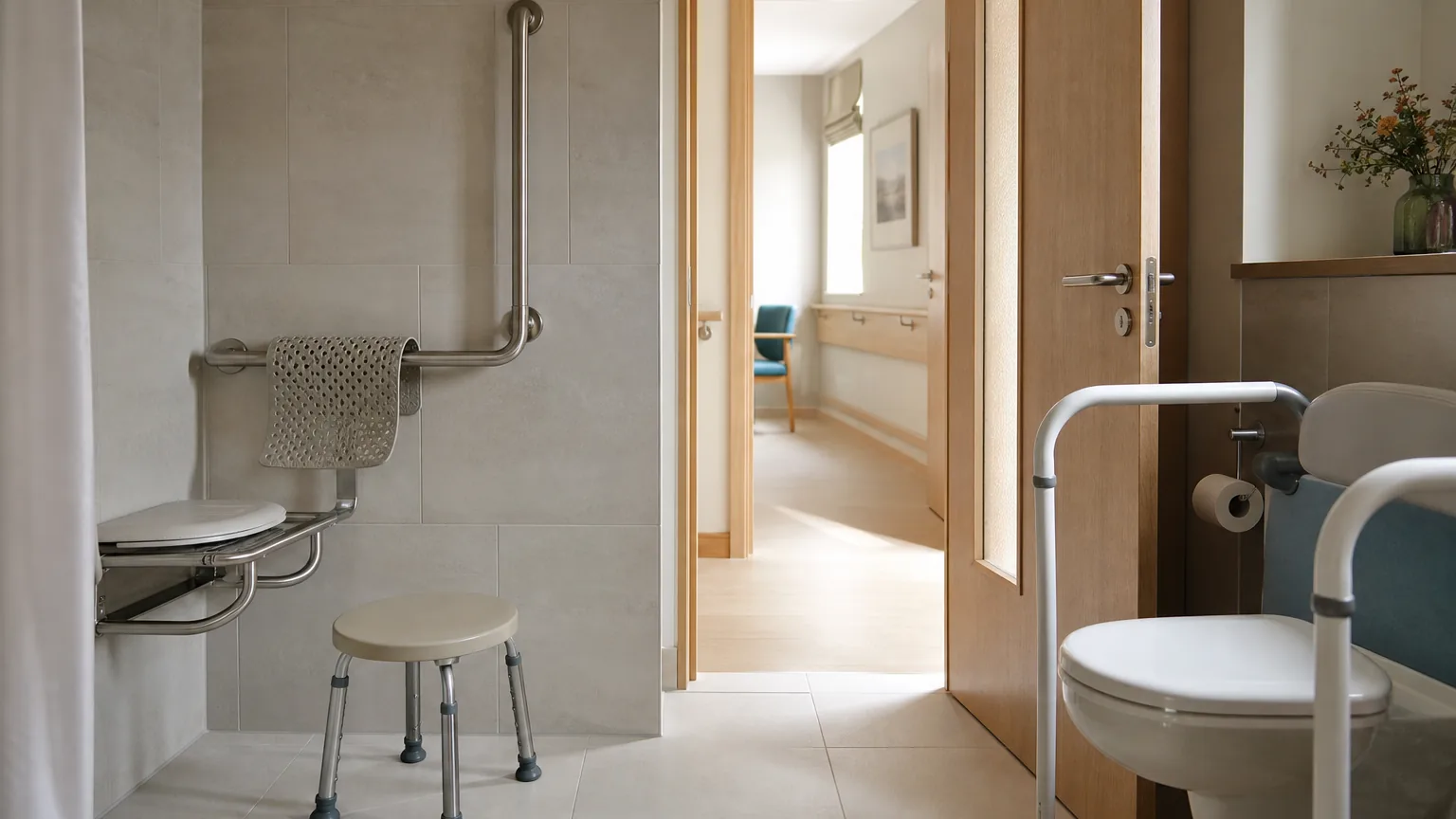
Why the bathroom is the room that resists monitoring
Three things happen in a bathroom that happen nowhere else in a care home: clothes come off, the floor gets wet, and the door closes. Each one removes a monitoring option. A camera is out on dignity grounds before privacy law is even mentioned. A wearable is out because the pendant is on the bedside table with the watch and the hearing aid. A bed or chair sensor is out because the resident is not in the bed or the chair. What remains is the door, the floor, and the staff.
The clinical shape of the risk is equally specific. A resident who needs the toilet at night is standing up quickly from a low bed, walking on a wet floor in slippers, and lowering themselves onto a toilet that may be lower than the one at home — often while taking a diuretic or a sedative that makes the trip urgent and the balance worse. The transfer onto and off the toilet is the moment that most often goes wrong, and it happens behind a closed door.
This is why bathroom fall detection is not a product category in the way a fall-detection system is. It is a design and staffing problem with a small number of technical components, and a home that buys a device without changing the room and the check interval has bought the least useful part.
The detection options that work without a camera
Four approaches cover the room, and they are complementary rather than competing. The table sets out what each one actually reports, because the difference between them is the difference between knowing a resident is in the bathroom and knowing a resident has fallen in it.
| Approach | What it reports | Where it is fitted | What it does not tell you | Cost of getting it wrong |
|---|---|---|---|---|
| Door contact sensor | The door opened, the door closed, and how long it has been closed | The bathroom door frame | Whether the resident is standing, sitting or on the floor | A closed door that has been closed for 12 minutes is the alert, not the fall |
| Occupancy or presence sensor | A body is in the room, and movement or stillness over time | Ceiling or wall, outside the shower zone | The difference between sitting still and lying still | Best used as a time-in-room limit rather than a fall alarm |
| Floor mat with weight sensing | Weight on the floor, and a load that stays down | In front of the toilet and beside the shower | A fall onto a part of the floor the mat does not cover | A mat that is lifted for cleaning stops reporting |
| Personal alarm with a pull cord | The resident pressed it, or pulled the cord | Cord beside the toilet; pendant on the resident | Anything, if the resident is unconscious or cannot reach it | The resident who falls and cannot reach the cord is the case it misses |
The door sensor is the cheapest and the most under-used. It does not detect a fall. It detects a room that has been occupied for longer than the resident needs, which in a care home is a reliable proxy for something having gone wrong — and it works whether the resident is on the floor, wedged beside the toilet, or simply unable to stand up again.
The mat answers a different question: did the body reach the floor. Fitted in front of the toilet and beside the shower, it catches the two transfers that fail most often. It will not catch a fall onto the far side of the room, and it must be on a cleaning schedule that does not leave it stacked in a cupboard for an afternoon.
Design measures that reduce the fall before it happens
The most effective bathroom fall detection is a bathroom where the fall is less likely and less damaging. Chapter 4 of the Code of Practice for Residential Care Homes (Elderly Persons) covers building and accommodation, including toilets and water supply, and a home's own occupational therapist or a community nurse can usually walk a bathroom in ten minutes and name the changes. The list is short and unglamorous: a grab rail beside the toilet and another inside the shower, a shower seat at the right height for the resident rather than for the room, a non-slip floor that is actually non-slip when wet, a light that comes on before the resident stands up, and a toilet height that matches the resident's own.
Two of those deserve a second look. A grab rail is only useful if it is where the resident's hand goes when they stand, which is forward and slightly to the side, not behind them. And a raised toilet seat or a toilet frame changes the transfer more than any sensor, because it removes the controlled fall that a low toilet produces in a resident with weak quadriceps.
Lighting is the measure most often left out. A resident who cannot see the floor does not step carefully; they step confidently and wrongly. A motion-triggered light at ankle height, on before the feet reach the floor, costs less than a sensor and prevents the trip that sends someone into the door frame.
The closed door: staffing practice, not technology
Every care home has a bathroom door policy, and most of them are unwritten. The question a home should be able to answer is: when a resident closes the bathroom door, how long is it before a member of staff checks, and what does the check consist of? A knock and a reply is a check. A knock and silence is an incident, and the response should be immediate entry rather than a second knock.
A maximum time in the bathroom — ten or fifteen minutes depending on the resident — is the most useful single rule, and it is a rule a door sensor enforces automatically. It also gives the night shift something concrete to do with the information, which is the failure mode of most monitoring: the alert arrives and nobody has decided in advance what it means.
This is where the restraint question enters. A home that locks the bathroom, or removes the door, to make observation easier has traded one risk for another one, and restraint use in care homes sets out why the alternatives are usually better. A half-door, a curtain, or a door that opens outward are all cheaper than a restraint incident.
What the monitoring layer can honestly do about it
A camera-based system covers the corridor outside the bathroom and the bedroom the resident left. That is not nothing: the walk to the toilet at 3 a.m. is where a resident who is unsteady is most exposed, and night-time falls are the events a corridor camera sees earliest. But the moment the door closes, the camera's usefulness ends.
The honest architecture is therefore a chain rather than a device. A bed-exit sensor reports that the resident has left the bed at an unusual hour. A corridor camera confirms which way they went. A door sensor reports that the bathroom is occupied and starts a clock. A mat reports weight on the floor. The staff response closes the chain. No single link is a fall detector in the bathroom, and together they shorten the time between a fall and someone opening the door.
Steadicore is the monitoring system SilverGuard builds, and this is the limit we state on its page: it watches rooms a camera can see, it flags fall-like patterns for staff verification, and it does not see into a bathroom. A home that expects a camera to solve the bathroom will spend money and still be surprised by the event it most wanted to catch.
A checklist a care home can actually run this month
Start with the room, then the door, then the clock, then the device. In the room: grab rails beside the toilet and in the shower, a shower seat at the resident's height, a floor that grips when wet, a light that comes on at floor level, and a toilet height the resident can use. At the door: a sensor, or a written rule, that starts a timer when the door closes. On the clock: a maximum occupancy time per resident, written into the shift routine, with the night shift explicitly covered.
Then the devices, in the order of what they add. A floor mat in front of the toilet and beside the shower is the cheapest thing that reports a body on the floor. A pull cord the resident can reach from a seated position is the cheapest thing that lets them call. A personal alarm with fall detection adds coverage for the walk there and back, and the difference between a fall detection sensor and a personal alarm explains why the two are not substitutes.
Finally, record it. Whatever the home installs, the bathroom is the room where a review will ask what happened and when someone knew. A log of door times, checks and outcomes is the only evidence that the chain worked, and it is the same log that tells the home which link to fix next.
Frequently asked questions
- Can a fall detection camera be installed in a bathroom?
- It can be installed and it should not be. A camera in a bathroom is a disproportionate collection of intimate personal data under the Personal Data (Privacy) Ordinance, it removes the resident's dignity in the one room where that matters most, and condensation and steam degrade the image anyway. Use a door sensor, a floor mat and a check interval instead.
- Is a door sensor enough to detect a bathroom fall?
- No, but it is the cheapest component that reliably starts the clock. A door that has been closed longer than the resident needs is a strong signal that something is wrong. It does not tell you whether the resident has fallen or is simply taking longer, so it must be paired with a check, not treated as an alarm on its own.
- How long should a resident be left in the bathroom before staff check?
- The home should set the limit per resident rather than per building, because the right number depends on how long that person actually needs and how much help they accept. Ten to fifteen minutes is the range most homes settle on. What matters is that the limit is written down, that the night shift knows it, and that a silent answer to a knock means entering.
- Do floor mats work in a wet bathroom?
- A sealed mat designed for the purpose does, but it must be the right kind: a mat that sits flat, cannot be kicked out of position, and does not depend on a cable lying across a wet floor. It also has to survive the cleaning routine, because a mat that gets lifted every morning and put back at lunchtime reports nothing for most of the day.
Explore more
- Steadicore, and the rooms it covers : the monitoring layer, stated with its limits.
- Bed exit alarms in care homes : the first link in the chain, before the walk to the bathroom.
- Night-time falls in care homes : why the hours after midnight need a different plan.
- Restraint use in care homes and what to try first : before a locked bathroom door is treated as a solution.
- Camera fall detection, and what it misses : the corridor side of the same problem.
- SilverGuard Insights : our other notes on running a Hong Kong care home.
- Steadicore : the monitoring system we build, described in its own terms.
- Legaris : for the paperwork that follows an incident.
The product behind this note
CCTV sensing + SI (Superintelligence) · AI (artificial intelligence) risk prediction for aged care
Turns existing care-home CCTV cameras into a 24/7 contactless safety layer. Pose estimation spots fall-like patterns with no facial recognition, no raw video, and no wearables, so staff are alerted early.
Hong Kong aged-care tech watch
When a subsidy, a policy or a care-home rule changes, you get one clear note.
We read the HK policy papers, subsidy circulars and care-home notices, then send one short note when something actually changes: what changed, who it affects, and what to do next. No fixed schedule — if nothing moves, you hear nothing.
Related notes
- Camera Fall Detection: What It Sees and Misses
How camera fall detection works in a care home: pose estimation on existing CCTV, what it can and cannot see, privacy limits, and the response it still needs.
- Fall Prediction and Fall Detection for Care Homes
How to choose a fall detection system for a care home, and how fall prediction differs from detection: camera, radar and wearable options, and the vendor questions.
- Fall Detection Sensor vs Personal Alarm: The Real Difference
A personal alarm only works if the button is pressed; a fall detection sensor reads the fall itself. Compare pendant, wearable, radar and camera approaches.