
Brain games for older adults that an activity worker can run in ten minutes.
Ten minutes of play that fits a care shift.
In short
Brain games are short, low-pressure rounds that ask an older adult to remember, attend, name or sequence something, played for the pleasure of the round rather than for a score. Sanospark puts twelve of them on a tablet in Cantonese and English, in a ten-minute session one worker can run with up to four players.
Sanospark is a set of short, spoken, tablet-based games for older adults: memory, attention, language and simple movement rounds, in Cantonese and English, with three difficulty tiers and a session record. It is designed with care staff so that it survives a real shift, not just a demo.
Visit the site: sanospark.com(opens in new tab)
- Ten-minute session format
- Cantonese and English prompts
- Not an assessment, not a diagnosis
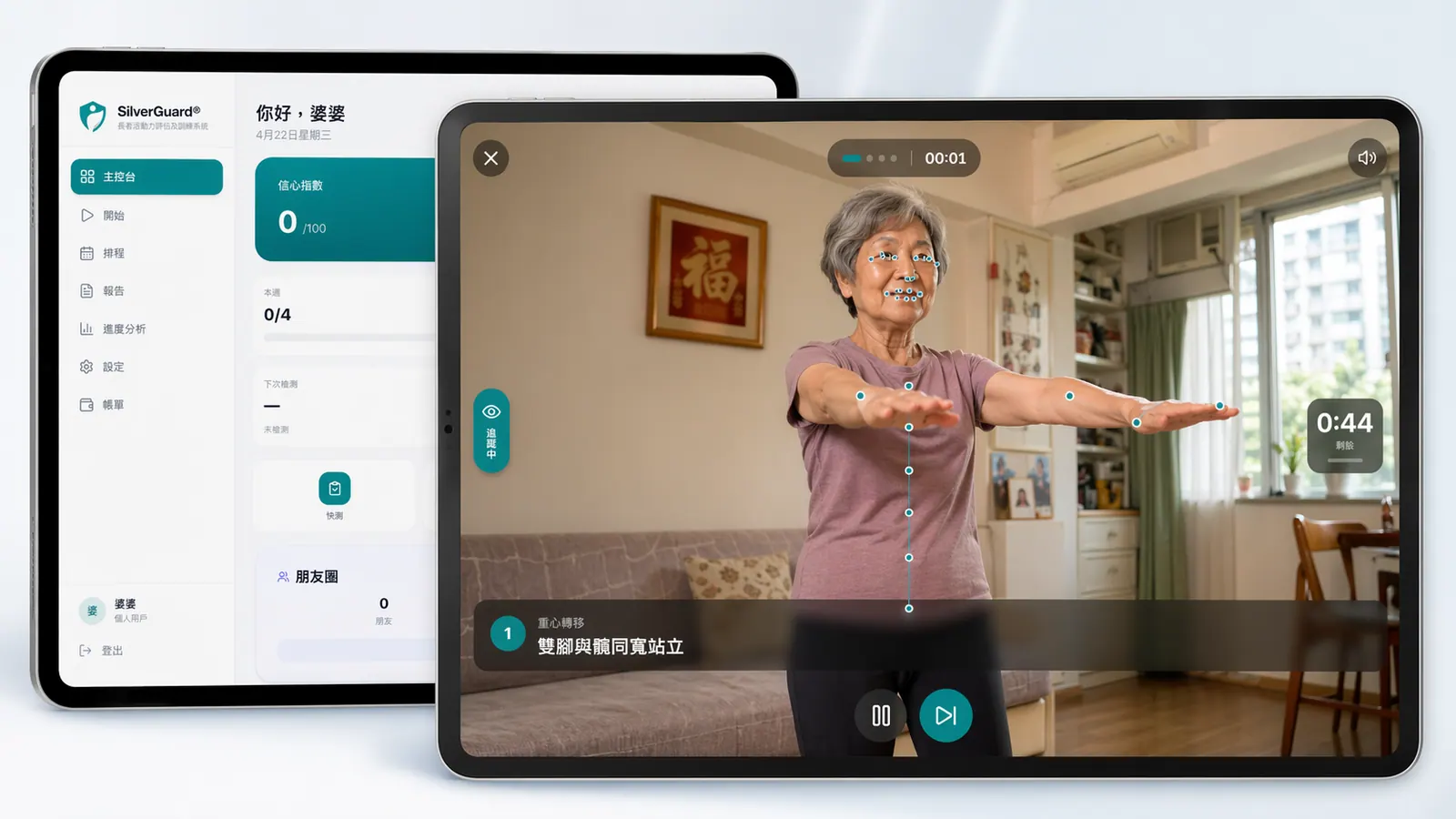
Who Sanospark is for
The people who search for brain games are almost never the person who will play them. They are the activity coordinator with an hour to fill on a Tuesday afternoon, the daughter looking for something to do with a parent who no longer follows a television programme, and the day centre that needs a group activity that does not humiliate the slowest person in the room. Each of those is a design constraint, not a marketing segment.
Activity coordinators in care homes (B2B)
One worker, eight residents, no preparation time. A session has to start in under a minute, run without a manual, and end on time. Sanospark is built around that shape: one tablet, spoken prompts, no materials to print.
Day centres and rehab groups (B2B)
An adult child visiting on a Sunday who wants twenty minutes of something shared rather than another television hour. The home version runs one-to-one and does not need a facilitator who has been trained.
Families at home (B2C)
Group sessions where the range of ability in the room is wide. Three difficulty tiers mean the same round can be played by people at different starting points without anybody being moved to a different table.
Activity time runs out before the games do
Ask a care worker why the activity cupboard is full of unused boxes and the answer is never that the residents did not enjoy them. It is that the box needs setting up, the instructions are in English, the pieces go missing, and the shift has forty minutes. A brain-training app on a phone does not fix that either, because it is built for one motivated adult playing alone on a commute.
- Most cognitive game material is paper, English and prepared for a school-age player, so an older adult in Hong Kong meets it as a test rather than a game.
- Generic brain-training apps are individual and self-directed: the person who most needs company is left playing alone, and the staff member has nothing to join in with.
- A game with a visible score that everybody can see turns a group activity into a ranking, and the person who scores lowest stops coming.
- Activities that need preparation do not happen on a bad shift, which is exactly the shift that needed them.
- Nobody records what was played, so the next worker starts from zero and the care review has nothing to say about activity.
Four ways to fill activity time, and what each one costs the shift
Every care home already has an activity cupboard, a television and a phone. The comparison is about what happens on the Tuesday when the worker has forty minutes and eight residents in front of them.
| Approach | What it needs before the session starts | What the session gives the group | Where it breaks down |
|---|---|---|---|
| Paper workbooks and printed worksheets | Photocopying, English instructions, and someone to explain the rules | A familiar task, quiet, and something to hold | Preparation is skipped on a bad shift, the pieces go missing, and an older adult in Hong Kong meets a school-age exercise as a test. |
| A generic brain-training app on a phone | A phone per person and an account; a player who wants to play alone | Individual rounds and a score that goes up | It is built for one motivated adult on a commute: the group is split, the worker has nothing to join in with, and nobody records what was played. |
| Television, music or a singalong | A screen or a speaker and a free half hour | Shared attention and no demand on the player | It asks nothing of the group, so the person who has stopped following a programme is left out of it. |
| Sanospark on one tablet | One tablet and a speaker; no printing and no preparation | A structured ten minutes: four rounds, spoken in Cantonese or English, one to four players, scores hidden in group mode | It is ten minutes of play, not therapy: it does not assess, diagnose or claim to delay decline. |
A session format, not a games library
Sanospark is deliberately small. Twelve rounds, each one playable in two to four minutes, grouped into a ten-minute session that has a beginning, a middle and an end. The prompts are spoken in Cantonese or English so nobody has to read a rule. The tablet is the only equipment. The SI (Superintelligence) · AI (artificial intelligence) layer does one narrow job: it adjusts the difficulty of the next round to how the last one went, and it writes the session summary the worker would otherwise write by hand.
Ten-minute sessions
A warm-up round, three game rounds and a closing round. Short enough to fit between a medication round and lunch, long enough to be worth sitting down for.
Spoken, bilingual prompts
Cantonese and English, with large type for the person reading over a shoulder. Nothing on screen requires the player to read a rule to start.
Error-free scoring
A wrong answer is met with the next clue rather than a red cross, and the round ends on a success. The point is that the player wants to come back tomorrow, not that the score is accurate.
A session record, not a clinical score
What was played, for how long, who joined in and what the worker noticed. That is what an activity review needs, and it is not a cognitive assessment, which Sanospark does not claim to be.
What is in the demo today
Sanospark is in demo development. Everything below exists and can be played in a session; the list is short on purpose, and the stage note on the products page says the same thing.
Twelve rounds across four skills
Memory, attention, language and sequencing, plus two seated movement rounds for a group that has been sitting too long.
Three difficulty tiers per round
The same game at three entry points, so a mixed-ability group plays together without being split up.
Cantonese and English audio
Recorded prompts rather than text-to-speech, because a synthetic voice reading Cantonese place names is harder to follow than a person.
Group or one-to-one
Group mode hides individual scores; one-to-one mode shows them to the facilitator only, never to the room.
Session summary for the file
A short written record per session that goes into the home's own activity log, exportable as a PDF.
Works offline after setup
Rounds are stored on the tablet, so a home with weak Wi-Fi in the activity room is not blocked by it.
The capability list, with the honest status
What Sanospark is, what it runs on, and the two things people assume it does and it does not.
| Capability | What it means in practice | Status |
|---|---|---|
| Equipment | One tablet. No cards, no printed sheets, no pieces to lose between sessions. | Available |
| Languages | Cantonese and English audio prompts; traditional Chinese and English on screen. | Available |
| Session length | A structured ten-minute session, with single rounds playable in two to four minutes. | Available |
| Group play | One facilitator, up to four players, individual scores hidden in group mode. | Available |
| Progress record | A written session summary for the activity log, exportable as a PDF. | Available |
| Cognitive assessment | Sanospark does not score cognition, screen for dementia or produce a clinical result. | Not offered, by design |
| Clinical claim | No claim that playing improves memory, delays decline or treats any condition. | No claim made |
| Price | No published price while the product is in demo development; a session can be tried before any commercial terms exist. | Not yet published |
How a Sanospark session runs
The design test for every decision below was whether a worker with no preparation time could run it on a bad shift.
- 1
Pick a session
One tap on the day's session. Rounds are pre-sequenced by skill focus and difficulty, so there is no planning step and nothing to choose under time pressure.
- 2
Sit down with one to four players
The tablet goes on the table. The first round is spoken and demonstrated, and it is designed so that the first answer is almost certainly right.
- 3
Play three rounds
Each round adapts its difficulty to the answers given. A player who is finding it hard gets a wider clue, not a lower score; a player who is finding it easy gets a longer sequence.
- 4
Close and record
The closing round ends on a success, and the session summary writes itself: what was played, for how long, who joined, and any note the worker added.
What running it takes, and what it does not cover
A session demo answers most of the buying questions on its own. These are the three that remain, and they are about the work around the tablet rather than the games on it.
Deployment and staff training
There is nothing to install in the building. A home books a session, runs it on its own tablet with the residents who will actually be in the room, and decides afterwards. Training is one demonstration: the first round explains itself, the facilitator learns the confirm and skip gestures during that session, and a one-page sheet covers what to do when a player wants to stop. A day centre running three groups a week needs about twenty minutes of briefing in total, and a family using the one-to-one version needs none, because there is no workflow to adopt.
Data privacy and the PDPO
A session record holds what was played, for how long, who joined and any note the worker wrote, which is personal data under the Personal Data (Privacy) Ordinance. The design keeps it to that: no video, no audio recording of the room, no clinical score, no face or voice profile. The record belongs to the home, is exported into the home's own activity file, and the family's consent and the home's retention policy decide how long it is kept. In the home version the family holds the record and nobody else can open it.
What is included, and what is not
Included: the twelve rounds, three difficulty tiers, recorded Cantonese and English prompts, group and one-to-one modes, the session summary and the PDF export, all working offline once set up. Not included: the tablet and speaker, a cognitive assessment, a dementia screen, any clinical claim that playing improves memory or delays decline, a printed workbook, or a therapist. A home that needs an assessment has a different problem, and should not buy this to solve it.
Hong Kong aged-care tech watch
When a subsidy, a policy or a care-home rule changes, you get one clear note.
We read the HK policy papers, subsidy circulars and care-home notices, then send one short note when something actually changes: what changed, who it affects, and what to do next. No fixed schedule — if nothing moves, you hear nothing.
Compared with the alternatives in the activity cupboard
Paper workbooks, a generic brain-training app and a television are the three things Sanospark actually competes with. Each is cheaper, and each fails in a specific way.
| Features | Sanospark | The usual alternative |
|---|---|---|
| No preparation before a session | Yes | No |
| Cantonese spoken prompts | Yes | Partial |
| Group mode with hidden scores | Yes | No |
| Adapts difficulty within a round | Yes | Partial |
| Written session record | Yes | No |
| Clinical assessment or diagnosis | No | No |
| Needs a facilitator in the room | Yes | No |
What people ask before a first session
The questions below are the ones that decide whether a home books a demo or closes the tab.
What counts as a cognitive game?
A game that asks the player to hold something in mind, notice a change, find a word or put things in order, and that is played for the round rather than for a result. The distinction that matters commercially is between a game and a test: a test is designed to measure, a game is designed to be played again tomorrow. Sanospark is the second kind, and the copy says so wherever it could be misread as the first.
What does it cost to run?
There is no published price, because Sanospark is in demo development and there is nothing to buy yet. A home can book a session and play it with residents before any commercial conversation. When pricing exists it will be published on this page with the same specificity as the Steadicore tiers, rather than left to a sales call. What we will not do is quote a number now that we cannot hold to next quarter.
What does the care worker have to do?
Choose a session, sit with the players, and add a line to the summary if something is worth noting. There is no preparation, no printing, no clearing away, and no training course: the first round demonstrates itself. The one thing that cannot be skipped is being in the room, because the value of the session is the shared attention, and a tablet left with a resident is just another screen.
What does Sanospark not do?
It does not assess cognition, screen for dementia, or tell a family whether a parent is declining. It makes no claim that playing improves memory or delays anything, because the evidence for that claim in the published literature is mixed and a product page is not the place to resolve it. It does not replace an occupational therapist, a day programme or a person. It is ten minutes of structured, sociable play, and that is the whole offer.
Will it run on the tablet the home already has?
A modern iPad or Android tablet with a speaker is enough. Rounds are stored on the device, so weak Wi-Fi in the activity room does not stop a session. A home with very old hardware should test one session on its own device before planning anything, which is what the demo is for.
The questions this page is written for
Short answers to the search queries behind this page. The longer answers are in the buyer's guide above.
- What are good memory games for seniors?
- Ones with a low cost of entry and a reason to play again: matching pairs with large pictures, remembering a short shopping list, finding what changed in a familiar scene. The game has to be winnable in the first minute, or the player decides it is a test and stops.
- Do brain training games for the elderly actually work?
- The published evidence for improvement on the trained task is reasonable; the evidence that it transfers to everyday memory is mixed. Sanospark therefore claims the thing that is defensible: a structured, sociable ten minutes that a worker can run, with a record. It does not claim to delay decline.
- Are these dementia activities for seniors?
- They are designed to be usable by people living with dementia, which is not the same as being a dementia treatment. The rounds avoid reading requirements, use familiar Cantonese words, and never display a total score in group mode. A person at an early stage and a person at a later stage can play the same round at different tiers.
- Is there a Chinese version?
- Traditional Chinese on screen and Cantonese audio prompts, with English alongside. The Cantonese prompts are recorded rather than synthesised, because a synthetic voice mispronounces the place names and food words these rounds use.
- Do we need to buy anything to try it?
- No. Sanospark is in demo development: book a session, run it with residents, and decide afterwards whether it is worth having. There is no published price and no contract to sign to see it.
- How long should a brain training session be?
- Ten minutes is the format here, and the reason is the shift rather than a claim about the brain. Four rounds of two to three minutes fit between a medication round and lunch, which is when a session actually happens. A longer session is not automatically better: attention in the room usually goes before the games do, and a round that ends on a success is worth more than a fifth round nobody wanted.
Further reading
The published notes that go with this product — written for the same operational questions, with the sources shown.
- Brain Training Games: What Makes One Work
Brain training games are judged on the domain they target, how difficulty moves, the evidence, and whether a 30-minute session can run twice a week.
- Games for Seniors: Which App Is Worth Installing
Games for seniors come down to six checks you can make in an afternoon: touch targets, contrast, ads, data collected, the tablet at home, and a two-week trial.
The other three products
Sanospark fills the activity hour. The same corridor usually has a fall risk, a family that cannot see the care plan, and a drawer of documents nobody has mapped.
Steadicore
Fall detection and risk software that reads the cameras a home already runs, with no wearable and no facial recognition.
Legaris
A map of an ageing parent's important documents, including the will and the enduring power of attorney, before a crisis needs them.
Easikin
A caregiver app that turns medications, appointments and handover into one daily plan the whole care circle can see.
Run one session with your own residents
Book a demo and we will run a live ten-minute session on a tablet, in Cantonese, with the people who will actually be in the room.