
Brain Training Games: What Makes One Work
SilverGuard Technologies Limited9 min read
Brain training games are built around one named mental task, such as holding a sequence, switching rules or matching pairs, with difficulty that moves as the player succeeds and a score that shows whether the task got easier over weeks. A pleasant card game is not one, because nothing in it is measured.
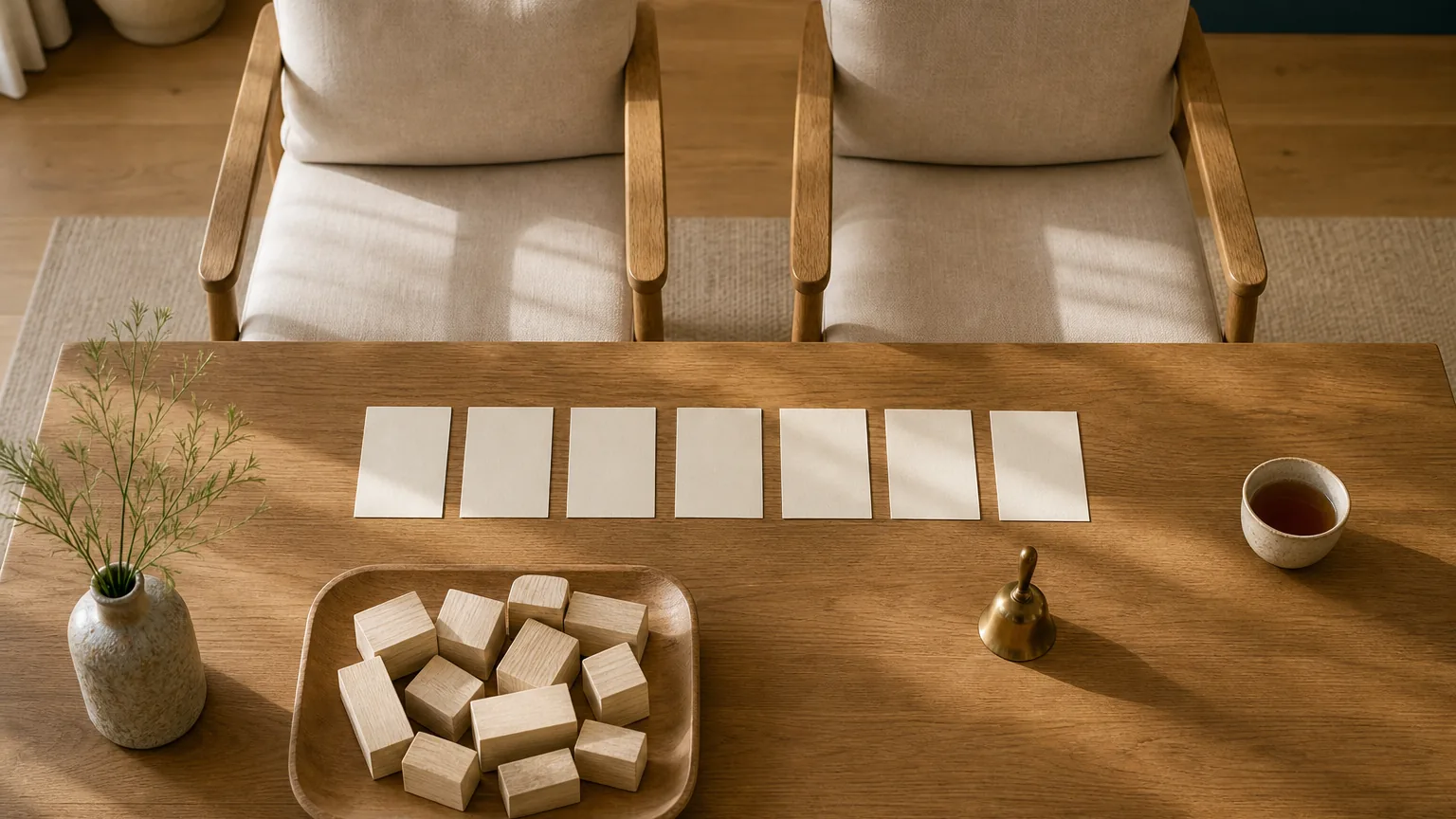
What separates a cognitive training game from a game
Four things, and a game needs all four to be called training, whether the family calls it a brain training game or a cognitive one. It targets a named mental task rather than a general idea of thinking. Its difficulty moves — up when the player succeeds, down when they struggle, without the player having to ask. It gives feedback within a second or two, so the player can tell whether the last action was right. And it produces a record that can be compared across sessions, which is what makes the word training mean anything.
Mahjong has three of the four. It demands working memory, planning and social attention, and people play it for hours. What it does not have is a difficulty ladder or a comparable record, so a care home can say that residents enjoy it and play it well, and cannot say whether anything changed over eight weeks. That is not an argument against mahjong; it is an argument for being precise about which claim the home is making.
The distinction matters commercially as much as clinically. A tablet app with bright colours and a cheerful voice is easy to sell to a worried daughter and hard to justify to an occupational therapist. Choosing a games app for older adults takes the buyer's side of that question, and this note takes the designer's.
Which cognitive domains a game can actually target
The domains that survive a tabletop or a touchscreen are the ones with a visible, scorable output. The table maps each to a task a care worker can set up this afternoon, because the best test of whether a game works is whether a person will play it twice.
| Domain | What it means in the room | A tabletop version | A screen version | What the staff member watches |
|---|---|---|---|---|
| Working memory | Holding something in mind while doing something else | Three objects covered, then named back | A growing sequence of lights or sounds repeated | Whether the player rehearses aloud, and whether that helps |
| Attention | Staying with one thing while another is present | Sorting cards while a radio plays | Finding a target among distractors | Whether the player's gaze drifts, and after how long |
| Processing speed | How quickly a correct decision is made | Naming the colour of the ink, not the word | Timed matching without a visible countdown | Whether speed costs accuracy, or accuracy costs speed |
| Executive function | Switching rules and holding a plan | Sorting by colour, then suddenly by shape | Rule changes announced mid-round | Whether the first wrong answer is followed by recovery |
| Language | Finding words and following instructions | Naming items in a category for 60 seconds | Word or picture naming | Whether the player circumlocutes or goes quiet |
Two cautions belong with the table. A game that mixes all five domains in one round is measuring the mix, not any one of them, and a change in the score cannot be attributed. And a domain is not the same as an everyday task: getting better at matching pairs on a tablet is getting better at matching pairs on a tablet, and the honest claim stops there unless the person also reports that something in the day got easier.
What the evidence supports, and what it does not
The World Health Organization's 2019 guidelines on risk reduction of cognitive decline and dementia recommend that cognitive training may be offered to older adults with normal cognition or mild cognitive impairment, and rate the certainty of that evidence as low. That is a permission, not a promise, and it is the correct frame for a care home: offering structured cognitive activity is reasonable, and claiming that it prevents dementia is not supported.
Read the wording closely, because it does two jobs. It says the intervention is low-risk and may be offered, which is enough to justify a session in an activity programme. It also says the evidence is weak, which means a home should not promise a family that a game will hold back a diagnosis, and a vendor should not print a claim that it will.
What the evidence is stronger on is the reason the session happens at all: structured activity, done with other people, is a defence against the afternoons when nobody comes. The case for activity as a defence against loneliness in care homes is more robust than the case for any particular game improving any particular score.
Designing a session that survives a care home afternoon
Thirty minutes, one domain, four to six people, and a staff member who is playing rather than supervising. That shape works because it fits the gap between lunch and tea, because one domain keeps the scoring meaningful, and because a group of six is small enough that nobody waits more than a minute for a turn.
Start below the player's level. The first two rounds should be ones the group will certainly pass, because the point of the opening is to establish that this is a thing they can do. Difficulty rises after success, not on a timetable. Stop while it is still going well — a session that ends on a win is a session that gets repeated, and a session that ends on three failures is a session that gets refused next week.
Have a stop rule for each player written into the plan: three consecutive errors, a change in mood, a request to stop, or a physical sign such as rubbing the eyes or shifting in the chair. The rule is not a judgement about the person. It is what lets a care worker offer the activity to someone with moderate impairment without spending the session afraid of getting it wrong.
Recording a score without turning the session into a test
Record three things per session and no more: which task, the highest level reached, and how long the player stayed engaged. Those three are enough to see a trend over a month, and they are few enough that a care worker will still be filling them in during the fourth week.
Do not turn the record into a cognitive assessment. A game score is not a MoCA, it is not a diagnosis, and a fall in the score is not evidence of decline — it can be a poor night, a new medication, a hearing aid left in the bedroom, or a room that was too noisy. What a falling score justifies is a conversation with the nurse and, if the pattern holds, a referral, not a conclusion written on a chart.
The same rule protects the family. A daughter who is shown a graph of her mother's declining scores will read it as a prognosis. A daughter who is shown which game her mother chose to play three times this week will read it as an afternoon that went well, which is what the record actually shows.
What to avoid, and where our own product stands
Avoid time pressure as a default. A countdown turns a task into a race and a race into a failure, and the residents most likely to be offered a cognitive game are the ones least able to win one. Where speed is the domain being trained, measure it quietly rather than displaying it. Avoid competition between residents, which produces one winner and five people who now know they were slowest. Avoid anything that looks like a children's toy, because an adult asked to play one is being told something about how they are seen.
And avoid the claim that the game is doing something medical. It is a structured activity with a score. If it is well designed, it is also the best thirty minutes of some residents' afternoons, and that is worth doing without inflating it.
Sanospark is the cognitive games line SilverGuard is building, and its games are in demo development rather than on sale. We describe it that way on the Sanospark site because the design rules above are the ones we would have to meet, and a demo is the honest way to find out whether we have.
Frequently asked questions
- Do cognitive training games prevent dementia?
- No claim of that kind is supported. The World Health Organization's 2019 guidelines say cognitive training may be offered to older adults with normal cognition or mild cognitive impairment, and rate the certainty of that evidence as low. Structured activity is worth running; it is not a preventive treatment, and no game should be sold as one.
- How long should a cognitive training session last?
- Around thirty minutes for a group, with one domain and a break offered halfway. Long enough to get past the settling-in, short enough that the last ten minutes are still good. A session that runs to an hour usually means the group is being kept there rather than choosing to stay.
- Should the score be shown to the resident?
- Show the level reached and the game played, not a trend line. A resident who is told they are declining has been given a prognosis by a game. A resident who is told they reached level four this week, when they reached three last week, has been given something true and useful.
- Can the same game be used for someone with moderate dementia?
- Often, at a lower level and with fewer rules, but not by pretending the difficulty is the same. The rules to keep are the ones that make the task recognisable; the ones to drop are scoring, timing and turn order. If the person cannot follow what to do after two demonstrations, the game is the wrong one rather than the person being unable.
Explore more
- Choosing a games app for older adults : the buyer's checklist that follows from this note.
- Loneliness in care homes and what activities are for : the stronger reason to run a session at all.
- The care home Code of Practice in Hong Kong : Chapter 16, the social care duty an activity programme answers.
- the SilverGuard product family : where the cognitive games line sits beside the monitoring line.
- SilverGuard Insights : our other notes on running a Hong Kong care home.
- Sanospark : the cognitive games line, currently in demo development.
- Steadicore : the same company's safety side.
- Easikin : for the family who wants to know what happened at the session.
The product behind this note
Cognitive training through play
Ten-minute cognitive game sessions a care worker can run on a tablet — cognitive training games with a session record. In demo development.
Hong Kong aged-care tech watch
When a subsidy, a policy or a care-home rule changes, you get one clear note.
We read the HK policy papers, subsidy circulars and care-home notices, then send one short note when something actually changes: what changed, who it affects, and what to do next. No fixed schedule — if nothing moves, you hear nothing.
Related notes
- Games for Seniors: Which App Is Worth Installing
Games for seniors come down to six checks you can make in an afternoon: touch targets, contrast, ads, data collected, the tablet at home, and a two-week trial.
- Manual Handling Injury Among Care Home Staff in Hong Kong
Manual handling injury among care home staff in Hong Kong: the Part VII duties, the eight transfer principles and the training records a home must show.
- Health Worker Registration in Hong Kong Care Homes
Health worker registration in Hong Kong is required before a care home may employ anyone in the post. The approved course, the CarePro route and renewal.