
An advance medical directive, and the rest of the documents a parent needs.
Know what your parents have, before you need it.
In short
An advance medical directive records the treatment a person would accept if they could no longer decide, and it is one of four documents a parent needs, beside the will, the enduring power of attorney and a written list of accounts, policies and property. Legaris maps that set, names what is missing, and keeps it encrypted.
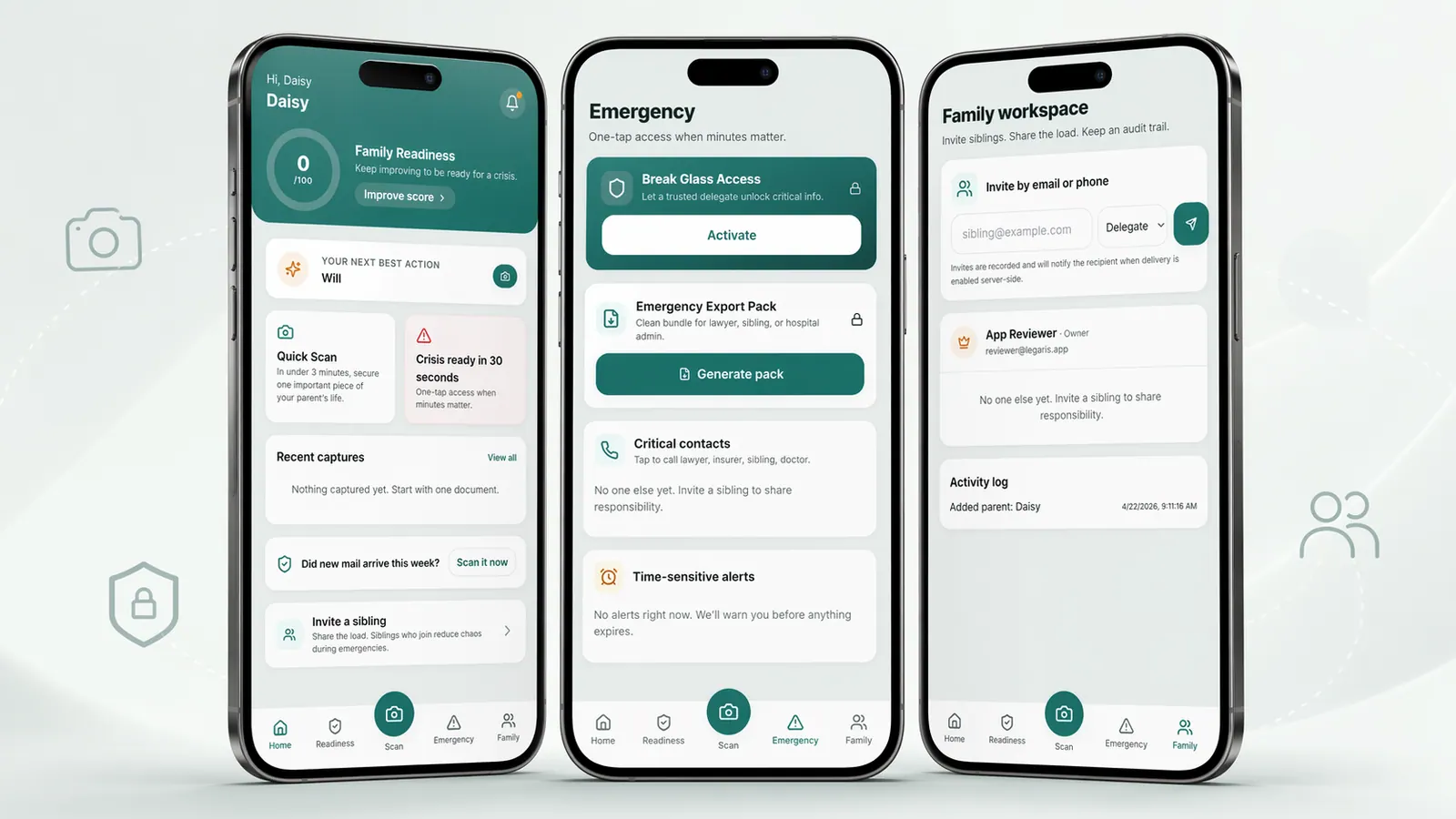
Legaris photographs the drawer, names each document, and shows what is missing: the will, the enduring power of attorney, the policies, the accounts, the cards. It is not a law firm and it does not draft anything. It makes sure a family knows what exists and where it is kept before a hospital admission asks.
Visit the site: legaris.co(opens in new tab)
- Encrypted on the device
- Named delegates
- Not legal advice
Who ends up doing this work
In most Hong Kong families the paperwork is nobody's job until it is an emergency, at which point it becomes the job of whichever adult child lives nearest. Legaris is built for that person, and for the two people who will need the same information later: the sibling who will argue about it, and the solicitor who will be handed a plastic bag.
Adult children (B2C)
The one who finds the bank statements in three different drawers and cannot tell which policy is current. The first job is not organising, it is naming: what exists, what is missing, what has expired.
Siblings and named delegates (B2C)
The people who will need access at the same moment, from different countries. Scoped access to a shared map ends the argument about who was told what, without handing anybody the originals.
Solicitors and estate planners (B2B)
A firm asked to draft a will or register an enduring power of attorney spends its first billable hour asking what documents already exist. A legible map shortens that hour and reduces the chance that a policy is missed.
Nobody searches for a document vault. They search for the document.
Families do not wake up wanting a filing system. They search for a will because a solicitor asked for one, for an enduring power of attorney because a parent has just been diagnosed, or for a list of important documents because a parent has been admitted and somebody needs the insurance policy number. By then the drawer has already been emptied onto a table.
- A will that was drafted in 2009 may name an executor who has since died, and nobody knows until probate starts.
- An enduring power of attorney that was signed but never registered with the court cannot be used when it is needed, and the family discovers this at the worst moment.
- Accounts, policies and property are spread across banks, insurers and a safe deposit box whose key is in a bowl.
- The sibling who lives overseas has no idea what has been done, so every conversation starts from the beginning.
- Password managers protect logins, not the deed, the policy or the medical letter, and a filing cabinet protects nothing if nobody knows what is in it.
Four ways to hold a parent's documents, and what each does on the day
The alternatives are a plastic bag, a folder, a password manager and a solicitor's file. One of them is free, and the difference is what happens at eleven at night when somebody needs to know whether a directive exists.
| Approach | What it holds | What it says when something is missing | Where it breaks down |
|---|---|---|---|
| A drawer or a plastic bag of originals | The paper itself, in whatever condition it survived | Nothing: a missing document is only noticed when somebody asks for it | Nobody else knows what is in it or where the key is, and a 2am admission does not wait for a search. |
| A folder or a spreadsheet index | A list of what exists, typed once | Nothing, unless somebody remembers to update it after every new policy | It goes stale silently, and a spreadsheet of account numbers is the wrong thing to leave unencrypted. |
| A password manager or a cloud drive | Logins and scans, if somebody has already scanned them | Nothing: it stores what you gave it and has no idea what a household usually holds | It protects a login, not the deed or the directive, and it cannot tell you which document type is absent. |
| Legaris | Photographs of the set, named by document type and institution, with the originals left where the family keeps them | A named gap list: there is a will but no registered enduring power of attorney, a hospital card but no advance medical directive | It does not draft, witness, register or advise, so a gap it finds still has to be closed by a solicitor or a doctor. |
A map of the documents, not a replacement for them
Legaris is a document map. You photograph what exists, it reads the document type, the institution and the date, and it files it under a name a family can search. What it adds is the gap: a list of what a person of that age and situation usually has, compared against what has actually been photographed. The legal work stays with a solicitor; the remembering is what Legaris does.
Scan and name
Photograph a letter, a card, a policy schedule or a will. Legaris reads the institution, the document type and the date, and puts it where a family would look for it.
The gap list
A view that says, plainly: there is a will but no enduring power of attorney; there is a home insurance policy but no record of the mortgage; there is a hospital card but no advance directive.
Named delegates
Decide in advance who can open the map, and under what condition. Access is scoped and logged, so a sibling in Vancouver and a solicitor in Central see only what they were given.
Encrypted before it leaves the phone
Sensitive fields are encrypted on the device. The map is readable to the people it was shared with and to nobody else, including us.
What is in the product today
Legaris is in development with an early-access list. The list below is what exists in the build being shown, not a roadmap dressed as a feature list.
Document capture
Camera or photo library. One document per capture, named automatically by type and institution.
Gap list
A checklist of the documents a household usually holds, with the missing ones named rather than implied.
Delegate access
Named people, scoped permissions, and a log of every open, so access is a decision rather than a favour.
Reminders that are not nagging
A quarterly prompt to add whatever arrived in the post, and a prompt when a document is about to expire.
Encrypted fields
Account numbers and identifiers are encrypted on the device; the visible map shows the institution and the type.
Export for a solicitor
A single encrypted package listing what exists, what is missing and where the originals are kept.
The capability list, with the honest status
The table below is the one a family should read before paying for anything, because the boundary between a document map and legal advice matters.
| Capability | What it means in practice | Status |
|---|---|---|
| Document scanning | Photograph a letter, card or policy; Legaris names the type and the institution. | Available in the demo build |
| Gap list | A named list of what a household usually holds and what is missing. | Available |
| Delegate access | Named people with scoped access and a log of every open. | Available |
| Encryption | Sensitive fields are encrypted on the device before they leave it. | Available |
| Will drafting | Legaris does not draft, witness or advise on a will. A solicitor does that. | Not offered |
| EPA registration | Registration of an enduring power of attorney is an application to the High Court, not something an app can file. | Not offered |
| Storing originals | The originals stay where the family keeps them; Legaris records where that is. | Not offered by design |
| Legal advice | No advice on what a document should say, or whether it is valid. | Not offered |
From a drawer to a map in four steps
The work is front-loaded on purpose: an hour with a parent's paperwork while they can still answer questions is worth a week of guessing afterwards.
- 1
Create a profile for the parent
A profile per person, not per family, so two parents do not become one pile. Biometric lock on the phone itself.
- 2
Photograph what exists
Start with the four that matter: identity, will, enduring power of attorney, and the latest insurance or medical letter. Ten minutes gets a usable first draft.
- 3
Read the gap list
The map names what is missing. That list, not the scanned pile, is the output: it is what a family takes to a solicitor.
- 4
Name who can open it
Decide now, while nobody is in a hospital corridor, who gets access and when. Every open is logged.
What setting it up takes, and what it does not cover
Legaris is a small product with a hard boundary, and the boundary is the part worth reading before a family starts.
Deployment and staff training
For a family, setting up is one sitting: a profile per parent, the four documents that matter photographed first, the gap list read together, then the delegates named. Nothing is installed and there is no course, but one conversation cannot be delegated to an app, which is who the attorney should be, and it has to happen while the parent can still make that decision. For a solicitor's office the export is the handover: a single encrypted package listing what exists, what is missing and where the originals are kept, which is otherwise what the first billable hour is spent assembling.
Data privacy and the PDPO
Identity documents, medical letters and account numbers are personal data, and some of it is sensitive, so the design assumes the minimum. Sensitive fields are encrypted on the device before anything leaves it, access is scoped to named delegates and every open is logged, and the originals are never uploaded: the map records where they sit, not the paper. A family that would rather keep a paper index and no digital copy at all should do that, and the gap list still works on paper.
What is included, and what is not
Included: document capture, automatic naming by type and institution, the gap list, delegate access with a log, expiry and quarterly prompts, encrypted fields and the encrypted export for a solicitor. Not included: drafting, witnessing or advice on a will, registration of an enduring power of attorney, storage of originals, a valuation of an estate, or a judgement about capacity. Those sit with a solicitor, the High Court and a doctor, and a product that implied otherwise would be selling something it cannot deliver.
Hong Kong aged-care tech watch
When a subsidy, a policy or a care-home rule changes, you get one clear note.
We read the HK policy papers, subsidy circulars and care-home notices, then send one short note when something actually changes: what changed, who it affects, and what to do next. No fixed schedule — if nothing moves, you hear nothing.
Compared with a folder, a password manager and a template
The alternatives are real and one of them is free. The comparison is about what each one does at the moment somebody needs the document.
| Features | Legaris | The usual alternative |
|---|---|---|
| Names the document type from a photo | Yes | No |
| Shows what is missing, not just what exists | Yes | No |
| Named delegates with scoped access | Yes | No |
| Encrypted on the device | Yes | Partial |
| Drafts or advises on the legal document | No | No |
| Works with paper originals left in place | Yes | Yes |
| Free | No | Yes |
What families ask before they start
The questions below are the ones a family asks on the first call, including the two that are really legal questions and are answered by pointing at the ordinance rather than by answering them.
Which documents does an elderly parent in Hong Kong actually need?
A will, which in Hong Kong is governed by the Wills Ordinance (Cap. 30) and must be in writing, signed by the testator and witnessed by two people. An enduring power of attorney under the Enduring Powers of Attorney Ordinance (Cap. 501), which lets a named attorney handle financial decisions after the donor loses capacity, and which must be registered with the High Court before it can be used. An ordinary power of attorney under the Powers of Attorney Ordinance (Cap. 31) if a shorter, time-limited authority is needed. Beyond the legal set: identity documents, the medical record and hospital card, the list of bank accounts and MPF, insurance policies, the property deed or tenancy, and a written note of where the originals are kept.
Where does an advance medical directive fit beside the will and the EPA?
The three do different jobs at different moments. The will says what happens to property after death. The enduring power of attorney names who can handle money and property once the donor has lost capacity, and it has to be registered with the High Court before it can be used. The advance medical directive speaks about treatment while the person is alive and cannot decide, which is the one moment neither of the other two covers. A family that holds only the will has planned for the estate and not for the hospital; a family that holds only the directive has planned for the hospital and not for the money. Legaris records which of the three exist and where the originals are kept, because knowing that at an admission is the whole point.
What does a will or an enduring power of attorney cost?
We do not quote legal fees, because Legaris does not provide legal services. In practice both documents are usually drafted by a solicitor and priced per firm, so the honest answer is that the cost depends on the firm and the complexity. What we can point at: the Duty Lawyer Service runs a Free Legal Advice Scheme with no means test, which is where a family with a straightforward question should start before paying for a drafting appointment.
What does the family have to do?
About an hour to start, then ten minutes a quarter. The first session is a photograph of everything that already exists; after that, the work is adding whatever arrived in the post and reading the gap list. The one thing that has to happen with the parent present is the conversation about who the attorney should be, because that is a decision the parent makes, not the child.
What does Legaris not do?
It does not draft a will, witness anything, register an enduring power of attorney, or tell you whether a document is valid. It does not hold the originals and it is not a substitute for a solicitor. It does not decide who should be the attorney, and it does not make a family agree. It records what exists, names what is missing, and keeps a log of who looked.
Is it safe to put these documents in an app?
That is the right question to ask, and the answer has to be structural rather than a promise. Sensitive fields are encrypted on the device before they leave it; access is scoped to named people and logged; the originals stay where the family keeps them, and the app records where that is rather than copying them. A family that is not comfortable with any digital copy should keep a paper index instead, which is free and better than nothing.
The questions this page is written for
Short answers to the queries behind this page. The legal detail sits in the buyer's guide above and in the ordinances named there.
- What is the difference between a will and an enduring power of attorney?
- A will says what happens to a person's property after death. An enduring power of attorney says who can handle a person's financial affairs while they are alive but no longer able to decide. A family usually needs both, and one does not replace the other.
- Can we write a will ourselves in Hong Kong?
- The Wills Ordinance (Cap. 30) sets the formalities: the testator must be 18 or over, the will must be in writing, signed, and witnessed by two people present at the same time. A home-made will that misses a formality can fail. Legaris does not supply a template, because a template is not advice and the failure mode is expensive.
- Where is an enduring power of attorney registered?
- With the High Court, under the Enduring Powers of Attorney Ordinance (Cap. 501). The attorney applies for registration, and the application requires a medical certificate confirming the donor's capacity at the time of signing. An EPA that was signed but never registered cannot be used when it is needed, which is the single most common gap this page exists to catch.
- What documents should an elderly person have in place before a hospital admission?
- The will, the registered EPA, the identity card, the hospital or medical record, the insurance policy numbers, the list of medications, and a written note of who to call. A hospital admission is the moment these are asked for, usually at a desk, usually at night, and usually by a relative who has never seen them.
- Is Legaris legal advice?
- No. Legaris is a document map. It records what exists and what is missing, and it points at the ordinance and the free advice scheme. Anything about what a document should say, or whether it is valid, belongs with a solicitor.
- What is an advance medical directive in Hong Kong?
- A written statement, made while a person still has capacity, of the treatment they would and would not accept if they later cannot decide for themselves. It is not a will and it is not an enduring power of attorney: a will speaks after death, an enduring power of attorney covers money and property while the person is alive, and the directive covers treatment while the person is alive. A family should know whether one exists before an admission, which is what the map is for.
Further reading
The published notes that go with this product — written for the same operational questions, with the sources shown.
- Hong Kong Will: What It Covers
A Hong Kong will is a signed, witnessed statement of who inherits what. Section 5 formalities, probate, fees, and the template mistakes families make at home.
- Enduring Power of Attorney: How Hong Kong Registers It
An enduring power of attorney in Hong Kong: the prescribed form, the doctor and the solicitor, the 28-day rule, and the High Court filing fee.
- Bought Place Scheme Care Homes: Tiers, Fees and Waiting
A bought place is a subsidised care home place the Social Welfare Department buys from a private home. What 甲一 and 甲二 mean, what a resident pays, and the wait.
- Advance Care Planning in Hong Kong Care Homes
How advance care planning and the 預設醫療指示 work in a Hong Kong care home under Cap. 651: the conversation, the record, the review and staff practice.
The other three products
Documents are one of four jobs. The same household usually also has a fall risk, an activity hour to fill, and a care plan scattered across a group chat.
Steadicore
Fall detection and risk software that reads the cameras a home already runs, with no wearable and no facial recognition.
Easikin
A caregiver app that turns medications, appointments and handover into one daily plan the whole care circle can see.
Sanospark
Brain games for older adults that an activity worker can run in ten minutes, with a session record for the care review.
Start with the drawer, not the lawyer
Join the waitlist and we will send the gap list as a one-page checklist you can use on paper this weekend, with or without the app.