
Care Home Fire Drills: What Hong Kong Requires
SilverGuard Technologies Limited9 min read
A Hong Kong care home must run a fire drill at least once every 6 months, keep proper records at all times for inspection, and display an evacuation route plan its staff are trained to follow. The drill is the only real test of whether that plan can move the residents who cannot walk out.
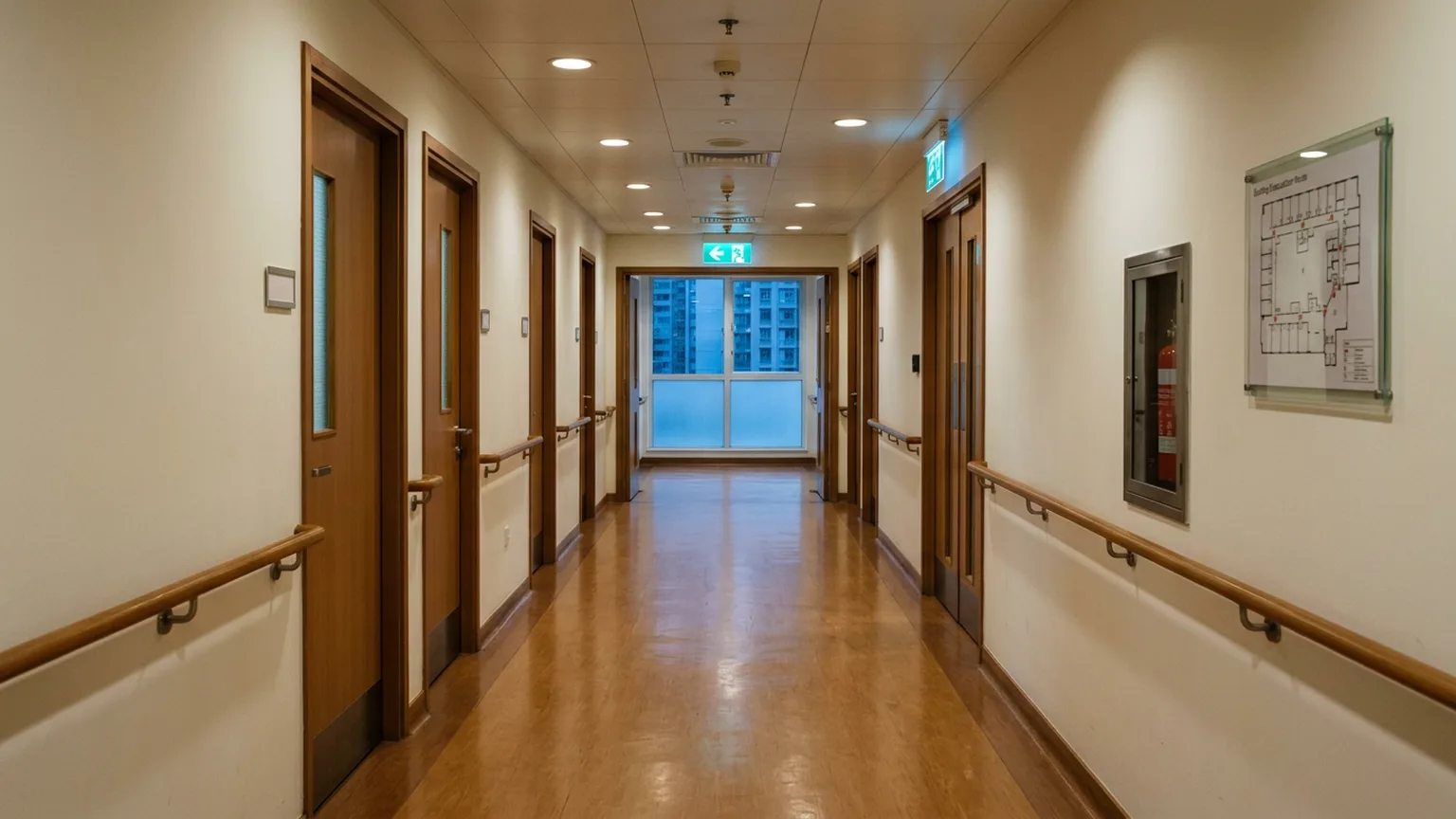
What the Code of Practice requires of a fire drill
The rule is short, and it is specific. Paragraph 5.5.6 of the Code of Practice for Residential Care Homes (Elderly Persons), in the text updated in June 2026, requires the operator to submit an emergency evacuation plan to the Social Welfare Department, to display the fire/emergency evacuation route plan at conspicuous locations, and to conduct fire drills at least once every 6 months with proper records kept at all times for inspection by staff of the department. Those three obligations sit in one paragraph, and they are one obligation in practice: a plan nobody drills is a document, and a drill nobody writes down cannot be shown to anyone.
The record is the part homes underestimate. Annex 5.2 of the same Code — the checklist of documents submitted with a licence renewal — lists the fire drill record as an item that “shall be still valid on the day of renewal”. A drill logged in January therefore has to be inside its six-month window again when the licence comes up for renewal. The drill calendar and the licence calendar are the same calendar, whether or not the home manages them that way, which is why a home that drills twice a year on fixed dates never has to reconstruct anything.
Two more paragraphs decide whether a drill is a drill. Paragraph 5.6.2 requires all staff to be fully conversant with the fire hazard and the actions to take — the use of fire-fighting equipment, evacuation procedures and routes — and sets out what any staff member who detects a fire must do: give an alarm to warn other staff, residents and visitors; ensure the fire is reported to the Fire Services Department on 999; and evacuate residents, “especially for those requiring assistance and under restraint”, jointly with other staff. Paragraph 5.6.8 adds that fire talks and drills should be arranged regularly in coordination with the local fire station, which is a free resource most homes underuse.
All of it reproduces the Residential Care Homes (Elderly Persons) Regulation, and the Code itself says so; where a figure matters, read it at the paragraph that states it. The full text is published as a PDF by the Social Welfare Department, and the Code’s own ordinance and code page is the place to confirm which revision is current.
What the evacuation plan has to contain
Annex 5.3 is the department’s guideline for the Emergency Evacuation Plan, and it has two parts. Part A is the fire safety instructions, written separately for three audiences: residents and visitors, care staff, and the home manager. Part B is the fire/emergency evacuation route plan, which has to show the general layout of the premises including the kitchen, switch room, store room, laundry, passages and exits; a legend with the location of every fire extinguisher, fire blanket, hose reel and manual fire alarm call point; the “You are here” point with the nearest route to an exit, and an alternative route where the premises have more than one; and the address of the designated assembly point on an auxiliary map that also shows the names of the surrounding streets.
Read that list as a test list for the drill, because it is one. If the assembly point marked on the wall is a street corner no member of staff has ever walked to, the drill has found something worth fixing — and a plan that names a route through a corridor now used for storage is worse than no plan, because staff will follow it.
Part A is where most plans are thinnest. Instructions written for residents and visitors are a different document from instructions written for staff, and the manager’s instructions are a third: who takes the decision to call 999, who accounts for which rooms, who meets the fire service at the entrance and tells them which compartment holds residents who cannot be moved. One sheet covering all three audiences usually ends up serving none of them.
The plan is submitted to the department and displayed, so it is a public commitment. Change the building — a new partition, a store room turned into a bedroom, a bed moved across a doorway — and the plan has to change with it. Renovation that touches exit doors, exit routes, the layout or the number and position of beds is notifiable to the licensing office in writing before work starts, which is the point at which the plan is either updated or quietly left wrong.
Who moves whom: horizontal evacuation comes first
The Code’s most demanding fire requirements apply to the part of a home used for dormitory purposes that sits more than 24 metres above the ground floor; anything above that height needs the department’s written authorisation, and for dormitory use that authorisation rests on meeting the additional requirements in Annex 5.1. Those requirements are structural — an open balcony approach to the dormitories, corridors wide enough for two beds with wheels to pass in parallel, a compartment zone large enough to hold the residents of the adjoining compartment at the same time, a refuge floor every 24 metres, an escape staircase that takes stretchers, a fireman’s lift large enough for one bed with wheels and two rescuers, and fire-resisting doors between compartments.
The management requirements in the same annex are the ones a drill can actually test. The premises on one floor should be run by a single operator so that horizontal evacuation is coordinated; training has to cover enough staff that all residents in an affected compartment can be moved to the adjoining compartment *simultaneously*; and a fire safety management plan has to cover the maintenance of fire safety provisions, the staff training plan and the fire action plan. Where structural requirements cannot be met, the department and the Fire Services Department accept alternative measures case by case — a smoke-free corridor connected to each dormitory, automatic window opening with smoke discharge area of at least 2% of the floor area, and enough wheelchairs and stretchers for vertical evacuation — but the management requirements stay.
The sequence those requirements describe is the one to drill. Move the residents of the affected compartment sideways, behind a fire-resisting door, before anyone tries to move them down a staircase. That first move is the step with minutes in it, and it is the step a home can practise without emptying the building. A drill that only rehearses the front-door assembly point rehearses the last five minutes and skips the first five.
What a drill should test, and which record proves it
The Code requires “proper records” and requires them to be available at all times, but it does not prescribe a form. That gap is an opportunity rather than a problem: the home designs the page, so the home can decide that the page proves four things rather than one. The table below takes the four that repeat in every failure and names the paragraph each one comes from.
| What the drill tests | Where the requirement sits | The record that proves it | Where it fails in practice |
|---|---|---|---|
| The alarm and the call to the fire service | Paragraphs 5.6.2(a) and (b); the detection alarm transmitted to the Fire Services Communications Centre under 5.4.3(a) | The time the alarm was raised and the time the 999 call was made | Staff wait for a colleague to call, or assume the direct link has already done it |
| Moving residents who cannot walk | Paragraph 5.6.2(c), including residents under restraint; the training requirement in Annex 5.1 | Which residents were moved, by which method, by which staff | The drill moves the mobile residents and never unclips the hoist or the evacuation sheet |
| The route itself | Paragraph 5.6.1 on unobstructed means of escape; 5.6.3(d) on exit routes | The nightly patrol record and the route notes from the drill | A trolley, a linen skip or a spare bed stands in the corridor on ordinary days |
| The doors | Paragraphs 5.6.3(b) and (e); 5.6.1 on exit doors openable from inside without a key | The patrol record, initialled each night | Doors are closed correctly on the round and propped open the other 364 nights |
The fourth column is the reason to keep the first three. A drill that produces a clean record and no finding is not evidence of a safe building; it is evidence of a drill that was designed to pass. The useful question after every drill is not whether the evacuation worked, but what the home had to move out of the way, unlock, or carry, in order for it to work.
The equipment duties a drill does not cover
Fire service installations are a separate obligation with its own dates. All installations have to be maintained in efficient working order and inspected by a Registered Fire Service Installation Contractor at least once every 12 months under the Fire Service (Installations and Equipment) Regulations, with the FS 251 certificate copied to the Fire Services Department and to the Social Welfare Department as proof of compliance. Where installations have to be shut down overnight or for more than 24 continuous hours, the contractor follows the Notification of FSI Shutdown procedure in the Fire Services Department Circular Letter No. 1/2021 — a shutdown is a managed event, not a quiet one.
The detection side has one detail that a drill can expose without anyone intending it. Under paragraph 5.4.3(a) the alarm from the fire detection system has to be transmitted to the Fire Services Communications Centre by a direct telephone link provided by an authorised service provider of the Computerised Fire Alarm Transmission System. If staff believe that link is the whole response, the drill is the moment to correct them: the link raises the alarm, and people still have to move residents.
Two requirements changed in the June 2026 revision, and both are dated. A 1 kg dry powder extinguisher is now required at each nurse station for homes licensed on or after 16 June 2026 and for licensed homes applying to renew, and draperies and curtains must now meet the fire resistance standard in BS 5867 Part 2 (Type B) or an equivalent accepted by the Director of Fire Services. Both are recorded in the Amendment Record, which is the only honest basis for saying what changed and when.
Then there is the nightly round, which is a fire precaution before it is anything else. Paragraph 5.6.3 requires patrols every night with a proper record confirming that cooking and heating appliances are switched off, that doors leading to common corridors are closed, that nothing obstructs fire service installations or exit routes, and that any locked door on a means of escape can be opened in the direction of egress without a key in an emergency. Five checks, one signature, every night — and the same five things a drill will discover if they have been skipped.
Running a drill that leaves a usable record
Design the record before designing the drill. One page is enough: the date and time, the staff on duty, the compartment drilled and the residents moved with the method used, the time from alarm to the last resident being in the adjoining compartment, the time the fire service call was made, what obstructed or failed, what was fixed and by whom, and the signature of the person in charge. The Code asks for proper records kept at all times; a single page that answers those questions is a proper record, and a page that only says the drill took place is not.
Put the two drills a year on dates set by the licence, not by convenience. A drill held within the six months before renewal, close enough that the record is comfortably inside its window on the day the application goes in, is doing two jobs at once; a drill held the week after renewal leaves the home relying on a record that will be nearly a year old when it next matters. Where the home has a fire safety management plan, the training that goes with it has to be repeated, not just the drill: staff who joined since the last drill have never walked the route.
Last, be precise about what a drill proves. It does not prove that a fire will be survived, and no drill can: it proves that a specific group of people, on a specific date, moved a specific set of residents along a specific route in a measured time, and that the things that went wrong are written down. That is a smaller claim than most certificates imply, and it is the only one the record can honestly support.
Frequently asked questions
- How often must a Hong Kong care home run a fire drill?
- At least once every 6 months. Paragraph 5.5.6 of the Code of Practice requires fire drills at that interval with proper records kept at all times for inspection by Social Welfare Department staff, and Annex 5.2 requires the drill record to be still valid on the day a licence is renewed.
- Is there a prescribed form for the drill record?
- No. The Code requires proper records, available at all times and valid at renewal, but it does not prescribe a form. That means the home designs its own page, and should design it to show who was moved, by what method, in what time, and what failed.
- Who has to be trained for the evacuation?
- All staff have to be fully conversant with the fire hazard and the actions to take, under paragraph 5.6.2. Where Annex 5.1 applies, training has to cover an adequate number of staff to evacuate all residents in the affected compartments to adjoining compartments simultaneously. The licensing office arranges fire safety training courses for care home staff.
- Does the drill cover the fire service installations?
- No. Installations are a separate obligation: they must be inspected by a Registered Fire Service Installation Contractor at least once every 12 months, with the FS 251 certificate copied to the Fire Services Department and the Social Welfare Department, and any shutdown of more than 24 hours follows the notification procedure in the department's Circular Letter No. 1/2021.
Explore more
- The care home Code of Practice in Hong Kong : the chapter map this note sits inside, chapter 5 included.
- Preparing for a care home licence inspection : the document set an inspector asks for, including the drill record.
- Locked doors and evacuation in a care home : why a locked exit door is a fire precaution problem before it is a wandering one.
- Night shift checks in a care home : the round that carries the fire patrol record.
- Care home risk assessment : where the building-level fire risk belongs in the assessment.
- SilverGuard Insights : our other notes on running a Hong Kong care home.
- Steadicore : the same alert-to-response discipline, applied to falls.
- Easikin : the day-to-day care log a drill record ends up beside.
Our products
Our products — Four products, one company. Each page describes what the product does today and what is still in development.
Hong Kong aged-care tech watch
When a subsidy, a policy or a care-home rule changes, you get one clear note.
We read the HK policy papers, subsidy circulars and care-home notices, then send one short note when something actually changes: what changed, who it affects, and what to do next. No fixed schedule — if nothing moves, you hear nothing.
Related notes
- Subsidised Care Home Places: Monthly Fees, Bought Places
Published monthly fees for subsidised care home places in Hong Kong, what the Enhanced Bought Place Scheme pays, and how the care home voucher fits beside them.
- Weight Loss and Malnutrition in Care Homes
Weight loss and malnutrition in care homes: the screening thresholds, mealtime observation, food fortification and the records that trigger a referral.
- Care Home Licence Application in Hong Kong
Applying for a care home licence in Hong Kong, step by step: form SWD 691, the plans and approvals that hold it up, the 36-month term and what it costs.