
Night-Time Checks in Care Homes: Running the Night Round
SilverGuard Technologies Limited7 min read
A night shift in a Hong Kong care home is two staff on duty from 6 p.m. to 7 a.m., a patrol recorded every night, health checks at fixed intervals, and a round the home defines itself. What decides the outcome is what the round checks, what is written down, and how a finding escalates before 7 a.m.
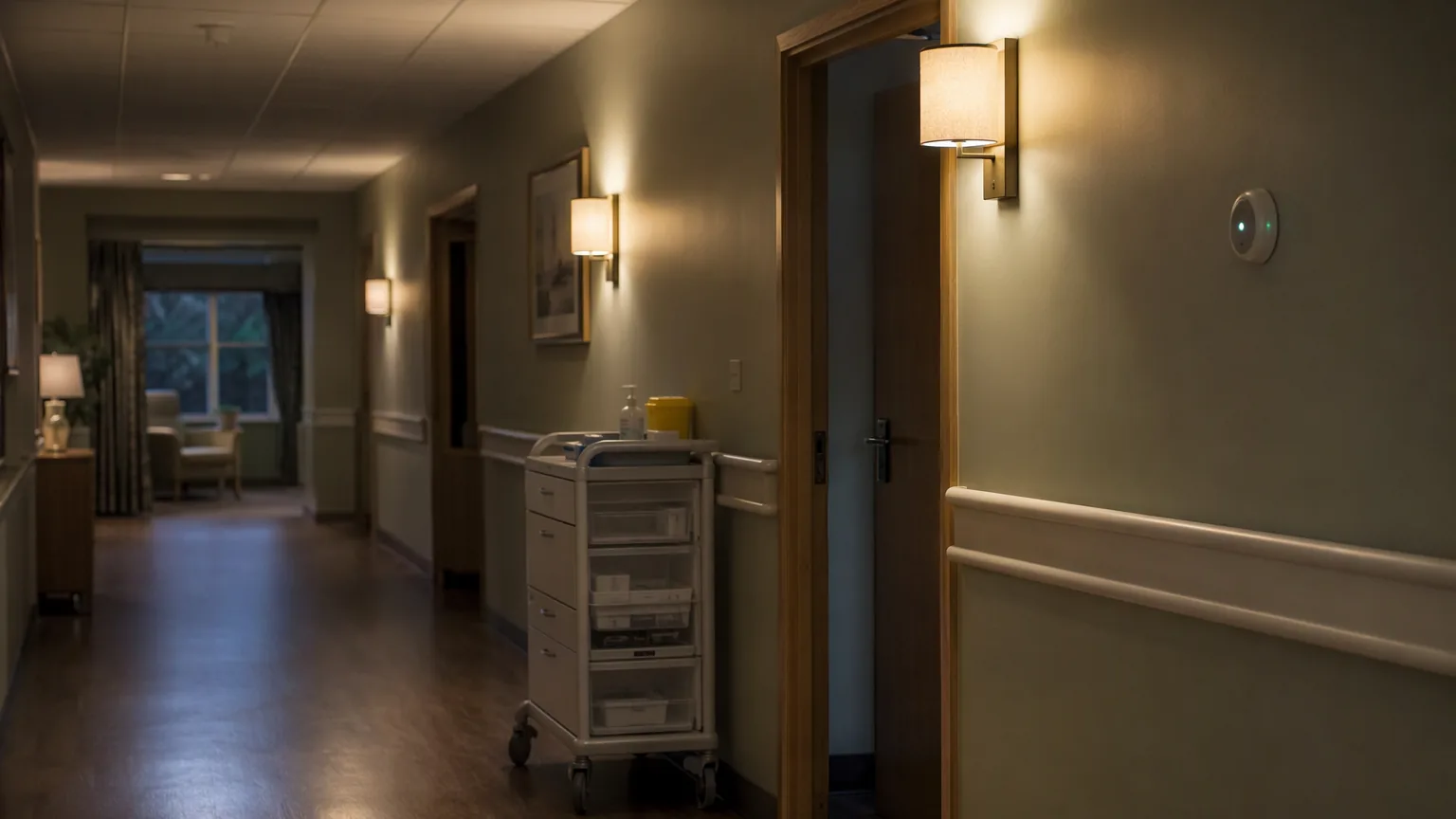
What the Code requires of the night shift, and what it leaves to the home
Night in a Hong Kong residential care home begins with a number rather than a policy. Schedule 1 to the Residential Care Homes (Elderly Persons) Regulation sets the minimum staffing for each type of home, and for a care and attention home the night row reads: from 6 p.m. on a day to 7 a.m. on the next day, 2 staff members on duty. The same row adds that those two may be people already counted towards another requirement in the table, and a separate row requires 1 staff member on site and on duty at any time when a resident is in the home. A self-care hostel is treated differently at night: 1 staff member on site whether or not on duty, and 1 on call whether or not on site. The Code of Practice for Residential Care Homes (Elderly Persons) reproduces those tables at paragraph 9.1 and adds, at 9.3.2, that there should be a minimum of 2 shifts of staff in attendance for all types of home.
Two consequences follow for the person running tonight. The first is that two is a floor, not a plan: the Code sets a headcount on duty, and a home may staff above it, but nothing in the Regulation or the Code allows a lower number because a home has bought monitoring equipment. The second is that the night requirement can be met by people who are also carrying a daytime ratio, so on some evenings the same two people answer to two rows at once. If the shift cannot be filled, the permitted answer is relief cover under paragraph 9.5, not a thinner night.
What the Code requires to be recorded at night is narrower than most managers assume. Paragraph 5.6.3 states that “patrols shall be conducted every night with proper record” to ensure that cooking and heating appliances are switched off, that doors leading to common corridors are closed, that fire service installations and equipment are unobstructed, that exit routes are clear, and that any locked door on a means of escape can be opened in the direction of egress without a key. That is a patrol with a written record, and it is about the building.
Resident observation is expressed differently, as an interval rather than a round. Paragraph 12.2.4 requires a health check, including temperature, blood pressure, pulse and blood oxygen level as appropriate, for residents with special care needs at least every 2 calendar days, and for other residents at least every 7 calendar days, with the records kept. Nothing in the Code sets a general round frequency for the home as a whole, but it does fix one case, and it is the one a night supervisor is most likely to be asked about: a resident under physical restraint must be released for examination, with blood circulation, skin condition, respiratory condition and degree of restraint checked and recorded at least once every 2 hours under paragraph 12.7.8, and a home manager, nurse or health worker must randomly check every restrained resident at least once a day and countersign the record under 12.7.9. Beyond that, the interval between night observations is the home's own decision, written into the night routine and the individual care plan, and once it is written down it becomes the standard the home is measured against. The design of the route itself is a separate question, and it is the one our note on why residents fall at night deals with.
What a 2 a.m. round checks, and what each check is for
A round is four kinds of check wearing one pair of shoes: the resident, the route and the building, the equipment in the room, and the things that will be needed before the morning. Which grade of staff walks it is a local decision, and the night row does not settle it, because the Code counts “staff members” rather than nurses. In most homes the walking is done by care workers, with a health worker or nurse available to be called, and that division is exactly what the escalation in the next section depends on.
| What is checked | Why it is on the round | How often | What is recorded |
|---|---|---|---|
| The resident: breathing, position, response, skin, pain | The change between two rounds is the finding; a resident who is settled at 1 a.m. and not at 3 a.m. is the reason the round exists | The interval the home sets for that resident, written into the night routine | Room, time, what was seen, who checked |
| The route: corridor, toilet, night light, rail, obstruction | Most night incidents begin on the way to the toilet, and an obstruction is cheaper to move at 2 a.m. than to explain at 9 a.m. | Every patrol of the night | What was moved or found, light failures, time |
| Fire safety items: cooking and heating off, corridor doors closed, exits clear, locked doors openable without a key | Paragraph 5.6.3 requires a nightly patrol with a proper record of these five items | Every night, with record | The five items, time, signature of the staff member |
| Room equipment: bed sensor or mat position, call bell within reach, oxygen and tubing, catheter, pressure-relieving surface | A sensor that has slipped senses nothing, and a call bell on the floor is not a call bell | Sensor position and call bell every round; the rest every shift | Device checked, fault found, who was told |
| A resident under physical restraint | Paragraph 12.7.8 requires release, examination and a signed record; a restraint nobody observed is a restraint nobody can defend | At least once every 2 hours, with a manager, nurse or health worker check at least daily | Blood circulation, skin, breathing, degree of restraint, time, signature |
| Medication trolley and keys | The trolley is the most dangerous object in the corridor after dark, and key custody is a named-person duty | After each drug round and at handover | Drug record signed, key custody, where the trolley is parked |
| Residents on the list of special care needs | They cannot express their own needs, so the observation has to be made for them | Every round, plus the 2-day health check | Observation, vital signs where taken, any change reported |
Two notes on reading that table. The interval column is the home's decision except where a source fixes it, and a home that writes “every two hours” has set a standard it will be held to, which is better than a routine that says “regular checks” and means whatever the shift has time for. And a round on which every row is ticked at the same speed has stopped being a round: the resident row is the one that requires standing still for a moment, and the record should show that someone did.
What gets written down, and where it goes
The Code gives the night shift one document of its own. Paragraph 8.7.2(i) requires a log book to be used by the staff on duty to record daily events, including irregularities observed on individual residents, emergencies and important environmental problems affecting the operation of the home, and follow-up actions on any accident. It is to be updated and signed properly by the staff concerned, submitted regularly to the home manager or designated staff for monitoring, and kept in the home for inspection.
Three other records sit underneath it, and they are not interchangeable. The Personal Health and Nursing Record under paragraph 12.5 carries the resident's condition over time: vital signs, weight, activities of daily living, intake and output, emotional and behavioural state, and special nursing needs such as incontinence care, feeding tubes or pressure injury prevention. The accident record under 8.7.2(b) has to be written instantly, with the date and time, what happened, the resident's condition, who was informed and when, and the remedial action. And the list of residents with special care needs under 8.7.2(m) is the document that tells the night shift who cannot call for help, with the home manager's own random checks and observations recorded against it.
The practical test of a night entry is thirty seconds. Can the person reading it at 7 a.m. tell what was seen, when, what was done, and who was told? Four facts, in that order, are enough. A round that was walked but not written is, for the purposes of the next shift and of an inspector, a round that did not happen, and the documentation habits that make an entry survive the shift are set out in our note on care home documentation.
The reason a night entry has to be written at the time rather than reconstructed afterwards is that inspections are unannounced. The Licensing Office's four professional inspectorate teams conduct surprise inspections at different times during and outside office hours, as a Government reply to a Legislative Council question of 22 June 2022 sets out, so the entry that matters may be read at three in the morning by someone standing in the corridor.
How a check escalates at 2 a.m.
The Code states the trigger for escalation rather than the ladder. Paragraph 12.2.5 requires that when a resident is sick, injured or there is a change in health condition, a health assessment is made immediately with a view to arranging consultation or seeking medical or nursing opinion, and that the family or contact person is informed of the condition with a record in the Personal Health and Nursing Record. What the home has to add is who does each step at two in the morning, because at that hour the answer cannot be a meeting.
The ladder a supervisor can actually run has five rungs, and each one has a named owner written into the night routine:
The first rung is noticing, and it belongs to whoever is on the round: the resident is not in the position they were left in, the breathing sounds different, the skin is cool or hot, the answer to a name is slower than it was last night. The second is a set of observations the staff member is trained and equipped to take, which in most homes means temperature, blood pressure, pulse, blood oxygen level and a conscious-level check, written down at the time rather than recalled later. The third is the call to the nurse or health worker on duty, or to the officer in charge if the home's night structure puts one person above the others; the name and the number belong in the routine, not in someone's memory. The fourth is the decision that has to be made once, on the spot: whether this is an emergency call now, or a referral to the visiting medical practitioner in the morning, or continued observation at a stated interval. The fifth is the record, and it is written before the shift ends.
The dividing line in that ladder is capability, not seniority. A care worker's job is to notice and to summon, and a home that expects the care worker to decide clinical questions alone has designed the escalation badly, whatever the policy says. Where the outcome belongs to someone else, the record is what carries it: a special incident such as serious injury, a missing resident requiring police assistance or a serious medical or drug incident requires a Special Incident Report to the Licensing Office within 3 calendar days under paragraph 8.7.2(j), and the 2 a.m. entry is the raw material of a report that someone else will write.
The 07:00 handover, and what the next shift inherits
The Code requires at least 2 shifts of staff in attendance, and the handover is the seam between them. Paragraph 8.7.2(i) makes the log book the written half of that seam and requires it to be submitted regularly to the home manager; the spoken half is what the outgoing shift says that no column on a form would prompt.
Four things have to cross the seam. Who is unwell, and how they changed during the night rather than only that they were seen. What was found and what was done about it, including the finding that was resolved and therefore looks invisible by morning. What is outstanding: a device fault written up but not repaired, a family not yet telephoned, a question for the visiting doctor. And the physical handover, which is the medication trolley, the keys and the residents who are awake.
The distinction that decides quality is between events and patterns. “Woke twice” is an event and it changes nothing. “Restless on the third night running, and up to the toilet four times” is a pattern, and it is the sentence that changes a care plan, a medication review or a sensor placement. The same rule applies on the family side of a handover, which our caregiver handover checklist sets out for the ten-minute conversation between a helper and a family.
The failure mode is a handover that is complete and useless: every resident mentioned, nothing said about the three who matter tonight. A supervisor can test the handover in one question at the door, which is what the incoming shift should leave knowing that it did not know at 9 p.m. If the answer is nothing, the night was recorded but not handed over.
Where sensor-assisted monitoring helps, and where it does not
A bed-exit sensor or a room sensor changes the timing of a round, not its content. It fires when a resident begins to leave the bed, which hands the night shift the seconds between movement and the corridor, and it does so without asking the resident to wear anything. Which device suits which resident, and how placement and tuning decide whether it is trusted, is the subject of our note on bed exit alarms in a care home; the question here is what the shift does with the alert.
Three things it genuinely does. It shortens the time between a movement and a response for the residents it is set for. It leaves a timestamp of when the alert fired and when someone answered, which is precisely the fact a night entry usually lacks. And it can hold a watch on a corridor or a shared bathroom between rounds, which is the gap that two people on duty cannot close by walking faster, as the arithmetic of the care home staffing ratio makes plain.
Three things it does not do. It does not prevent a fall, and no device should be described as if it did: the resident may already be on their feet before anyone arrives. It cannot check the things the round checks, which is skin, hydration, position, a catheter, a rail, an obstruction, or whether someone is oriented tonight. And it adds work rather than removing it, because every alert is a walk: a system that fires often enough will be answered slowly, and a night shift that stops trusting an alert has effectively switched it off.
The deployment rule that follows is narrow and defensible. Put sensing where the round is weakest, which is the resident who gets up without calling and the corridor nobody passes; keep the round for everything a sensor cannot sense; and read the alert log weekly against the written night entries, because where the two disagree one of them is wrong. That is the position SilverGuard takes on its own products: a sensor buys time, and the round is what spends it. The training side of running a shift like this sits with Sanospark, and the sensing and risk-monitoring work sits with Steadicore.
Frequently asked questions
- How often must staff check residents at night in a Hong Kong care home?
- The Code of Practice sets no general bedroom round frequency, though it fixes one case: a resident under physical restraint must be released and checked at least once every 2 hours under paragraph 12.7.8. It also sets health checks at least every 2 calendar days for residents with special care needs and at least every 7 calendar days for others, all recorded, and it requires a nightly patrol with a proper record of the fire safety items at paragraph 5.6.3. The interval between night observations is the home's own standard, written into the night routine and the care plan, and a home is measured against whatever it writes.
- How many staff must be on duty at night?
- For a care and attention home, Schedule 1 to the Regulation requires 2 staff members on duty from 6 p.m. on a day to 7 a.m. on the next day, and those two may be counted against another requirement in the same table. One staff member must be on site and on duty whenever a resident is in the home, and the Code requires at least 2 shifts of staff in attendance. A self-care hostel has a different night row: 1 on site and 1 on call.
- Does a bed sensor mean the night round can be reduced?
- No. A sensor shortens the time between a resident's movement and a response, and it leaves a timestamp of when the alert fired and when it was answered. It cannot check skin, hydration, position, a catheter, a rail or an obstruction, and it does not prevent a fall. Sensing belongs where the round is weakest, and the round still has to be walked.
Explore more
- Why residents fall at night : the route, the lighting and the reasons a round cannot fix what a corridor causes.
- Care home staffing ratio, and the 2-staff night rule : the night row of Schedule 1, the hours it covers, and why two people is a floor.
- Bed exit alarms in a care home : which sensor suits which resident, and why placement decides whether the shift trusts it.
- The handover checklist : the same five facts, spoken rather than written, in a ten-minute conversation.
- Care home documentation : how to write an entry that survives the shift and still reads at 9 a.m.
- Steadicore : the sensing and risk-monitoring side of night-time coverage, in our own family of products.
- Sanospark : training and competency for the staff who actually walk the round.
The product behind this note
CCTV sensing + SI (Superintelligence) · AI (artificial intelligence) risk prediction for aged care
Turns existing care-home CCTV cameras into a 24/7 contactless safety layer. Pose estimation spots fall-like patterns with no facial recognition, no raw video, and no wearables, so staff are alerted early.
Hong Kong aged-care tech watch
When a subsidy, a policy or a care-home rule changes, you get one clear note.
We read the HK policy papers, subsidy circulars and care-home notices, then send one short note when something actually changes: what changed, who it affects, and what to do next. No fixed schedule — if nothing moves, you hear nothing.
Related notes
- Care Home Staffing Ratio: 1 Carer per 20, 2 Staff at Night
Hong Kong's care home staffing ratio is 1 care worker for every 20 residents during the 10 specified hours, and 2 staff on duty from 6 p.m. to 7 a.m.
- Subsidised Care Home Places: Monthly Fees, Bought Places
Published monthly fees for subsidised care home places in Hong Kong, what the Enhanced Bought Place Scheme pays, and how the care home voucher fits beside them.
- Restraint Use in Care Homes: The Law and What to Try First
Restraint use in care homes is governed by section 33A of Cap. 459A, the Code of Practice and Nursing Council guidance. The frame, and what to try first.