
Stroke Rehabilitation in a Care Home: The First Month
SilverGuard Technologies Limited8 min read
After a stroke, a patient leaves hospital to one of three places: home with outpatient therapy, a geriatric day hospital, or a care home. A care home place works only if the home can manage transfers, swallowing, medication and mood, and if therapy continues; the first four weeks decide whether it does.
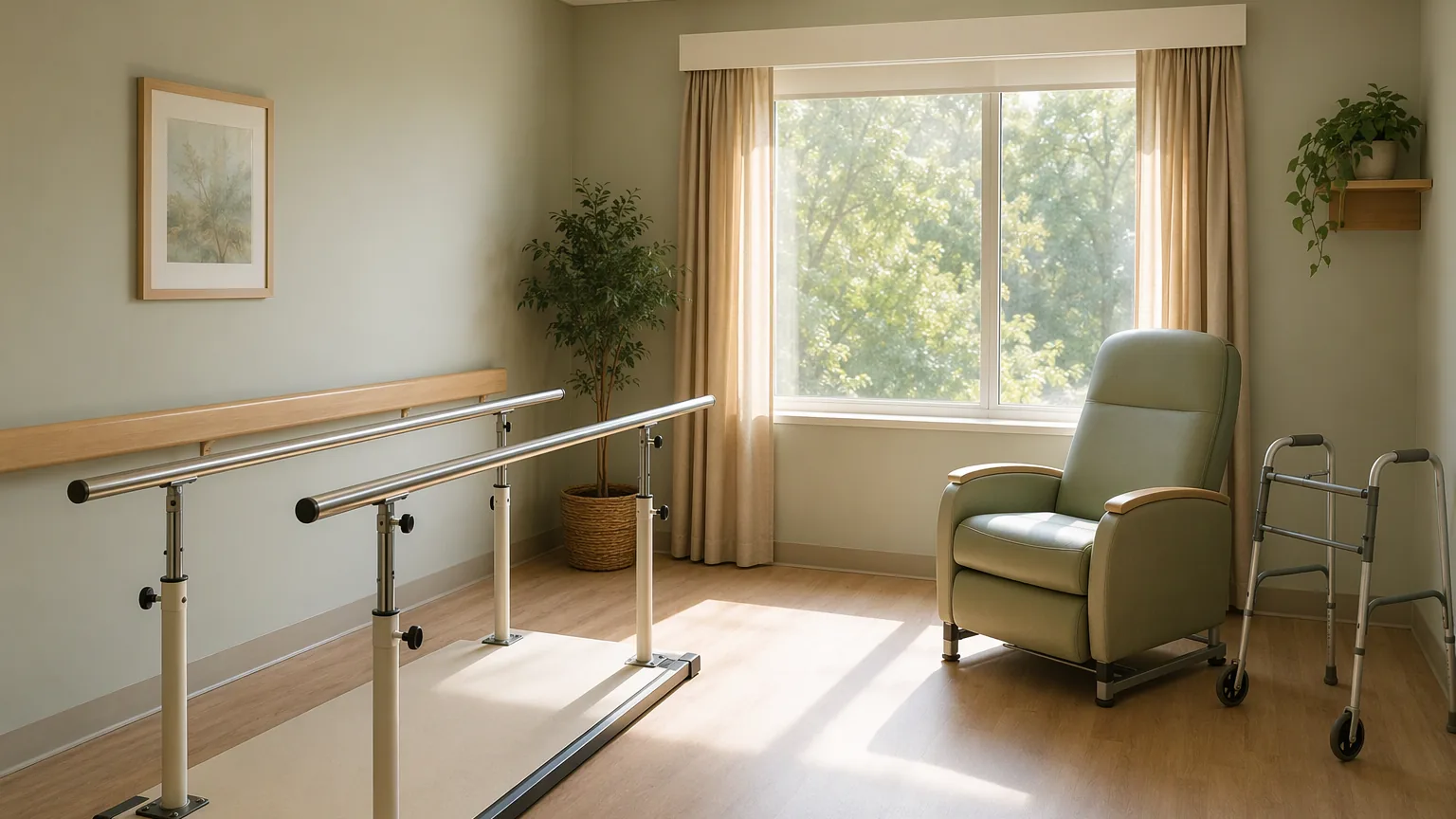
What happens to a stroke patient after hospital discharge in Hong Kong
The discharge date is set by the medical team, not chosen by the family, and the route out of an acute stroke ward in Hong Kong usually takes one of three shapes. A patient who can manage at home goes home with follow-up and outpatient therapy. A patient who cannot go home within the first two weeks may go to a rehabilitation hospital, which the Department of Health's stroke guide for older people describes as daily therapy over roughly two to four weeks. A patient who no longer needs hospital care but cannot yet manage at home, or whose family cannot supply the physical help, goes to a care home, and may continue therapy through a geriatric day hospital, which the same guide describes as about two to three months of training at around two days a week.
Two people do the practical work. The medical social worker attached to the ward starts the placement application and, where a subsidised place is wanted, refers the case onward; the Social Welfare Department accepts applications for subsidised long term care only on referral, from a medical social services unit, an integrated family service centre, or a district elderly community centre or neighbourhood elderly centre, and assesses by home visit and face-to-face interview. The family's own job is not to find a bed. It is to describe, in plain words, what the person could do before the stroke, because that is the baseline everyone will be measured against for the next year.
It helps to know what the hospital has already established. The Hospital Authority's patient information on stroke calls stroke the fourth fatal disease in Hong Kong, with about 30 per cent of sufferers dying within three months. Among survivors, it reports that more than half can fully resume self-care and fewer than one in five is left with severe disability. Those are averages across everyone who has a stroke and they say nothing about one parent on one ward. What they do say is that outcomes vary widely, that recovery depends on the size and site of the damage, the complications, the person's ability before the stroke and the rehabilitation that follows, and that a placement decided on day five is decided on very little information.
That is why a place chosen in the first fortnight should be treated as provisional. If the family is not ready to commit, a short stay is the least expensive way to test a particular home; respite residential care explains how those places are arranged and what they cost. The question this page answers is the next one: once the person is going into a home, what has to be true for the move to be a rehabilitation setting rather than a place to wait.
What a care home must be able to do for a stroke resident
A stroke changes the physical work of care. One-sided weakness means that a resident who looks settled in a chair may be unable to take weight through one leg, and that a transfer which takes one carer for another resident takes two here, with equipment. The Code of Practice for Residential Care Homes (Elderly Persons) does not license a home to accept every level of need; it requires the home to assess, plan and record what it can actually meet. These are the capabilities that decide whether it can meet this one.
- Transfer and hoisting. The Code requires staff to be trained, and written operating guidelines to be in place, before a lifter or hoist is used, and it requires the equipment to be inspected, maintained and the checks recorded. Ask which hoist, which sling, how many staff, and what happens at night when there are fewer of them.
- Positioning and the weak side. A hemiplegic shoulder is easily injured by being pulled, and a resident who cannot shift their own weight needs it done for them; the Code requires bedridden residents to be repositioned regularly, with skin kept clean and dry to prevent pressure injury. A home that cannot describe its turning routine in plain words does not have one.
- Mobility and therapy. Physiotherapy and occupational therapy may come from the home's own staff, a visiting service, or a day hospital; the Code expects a rehabilitation need and plan inside the care plan, and expects the home to work with visiting professionals, including the Hospital Authority's Community Geriatric Assessment Team and the Department of Health's Visiting Health Teams, which visit residential settings free of charge for health promotion rather than therapy.
- Swallowing. Stroke is one of the commonest reasons a care home resident is on a modified diet, and the texture level has to be written down, followed in the kitchen and reviewed when the person changes. Dysphagia and mealtime safety sets out what that looks like in practice.
- Medication. Most stroke residents leave hospital on secondary prevention: an antiplatelet or anticoagulant, blood pressure medication, a statin. The timing matters as much as the drug. Ask who gives the 8am dose, what happens if a dose is refused, and who is allowed to crush a tablet.
- Mood. The Department of Health's guide reports that about 40 per cent of stroke patients show signs of depression, that roughly 30 per cent develop it, that it can appear as early as seven to ten days after the stroke, and that it peaks between three and six months. A home that does not watch mood is not managing a stroke resident, however good its lifting equipment.
- Night cover and falls. The risk profile after a stroke is a person who cannot judge their own balance and may still try to stand. Fall prevention in a care home covers the environmental checks; the question for this home is who is awake, how many, and how a call bell or sensor is answered.
Questions to ask a care home before a stroke placement
Ask these in the home rather than on the telephone, and ask to see the answer rather than hear it. A good home will show you the hoist, the care plan template and the diet list; a home that answers only in assurances is telling you something.
| What to ask | What a workable answer sounds like | Why it decides the placement |
|---|---|---|
| How do you move a resident who cannot take weight through one leg? | A named method, named equipment and sling size, two staff at night, and a moving and handling assessment on file | Transfers are where residents and carers are most often hurt |
| Who provides physiotherapy and occupational therapy, and how often? | Staff on the home's team, or a named visiting service with a stated frequency, plus a plan to continue any day hospital sessions | Therapy in the first three to six months is the reason for the placement |
| How is a modified diet prescribed and reviewed here? | A speech therapist's recommendation written into the care plan, with the texture and fluid levels named and reviewed after any change | Swallowing changes; an unrevised texture is a choking risk |
| What happens with medication at 8am, and who may crush a tablet? | A medication chart with times, a named nurse responsible, and a clear rule that only a prescriber or pharmacist approves crushing | Stroke medication is secondary prevention; missed doses raise the risk of a second stroke |
| Who is awake and on the floor at 2am? | A number, a role, and how a call bell or sensor is answered | Night is when unsupervised transfers and falls happen |
| Who would notice if my father stopped eating, or went quiet? | A named key worker, a mood screen, and a review date already in the diary | Depression after stroke is common and peaks in the first months |
One question sits outside the table and deserves its own. What will you do that we cannot? A family that has been caring at home can usually feed, wash and sit with the person. What a home adds is the equipment, the second trained pair of hands at three in the morning, the therapy link and the record. If the answer is only a room and meals, the placement is being made for the family's relief rather than the resident's rehabilitation. That may still be the right decision; it should at least be a knowing one.
Day one: the care plan a stroke resident needs
The Code requires an individual care plan, drawn up with the resident and the family within one month of admission. Its required contents are specific: medical history, mental state, mobility, self-care ability, risk factors including swallowing difficulty, falls, wandering, cognitive impairment and depression, a nursing care plan, personal habits and daily activities, and a rehabilitation need and plan. The first formal review follows six months after the plan is written, then at least annually, or whenever the care needed changes.
A month is too long to wait for the things that keep someone safe in the first week, so the day-one conversation should produce a short interim plan even though it is not the document the Code describes. It needs nine lines, and the family should leave with a copy.
- Baseline. What the person could do two weeks before the stroke: walking, toileting, feeding, dressing, and whether they already used a frame. Everything later is measured against this.
- Transfer method. Named, not implied: one member of staff or two, hoist or standing aid, which side is weak, which arm is safe to hold.
- Positioning. How they sit, how often they are turned, which shoulder needs support, and the pillow arrangement that worked in hospital.
- Swallow status. Texture and fluid levels in writing, who prescribed them, and the date of the next review.
- Medication. The full list with times, what may be crushed, and the name of the nurse who owns the chart.
- Continence and skin. The continence plan, and where pressure areas are being checked and recorded.
- Mood and communication. Whether the person can say what they need, and who will notice if they stop eating or go quiet.
- The four-week goal. One sentence, agreed with the therapist, that the family can check against in four weeks.
- Who to call, and when. A name and number for the family, and the home's rule for telling them about a fall, a missed meal or a change in medication.
The first four weeks: what is reviewed, and when
The first month is when most of the change happens, in either direction. The Department of Health's guide calls the first three to six months the golden period of recovery, when the brain adapts fastest, and notes that many patients still improve more than a year after the stroke. That is the argument for reviewing at four weeks rather than waiting for the six-month review: not because the six-month review is wrong, but because the first month is where the trajectory is set.
| When | What is checked | Who should be in the room |
|---|---|---|
| Day one | The interim plan: baseline function, transfer method, diet texture, medication chart, family contact | Nurse in charge, care worker, family |
| Week one | Skin, weight, sleep, mood, falls and near misses, and whether the transfer method is actually working | Key worker and the home's nurse, with the family |
| Week four | Progress against the day-one goal, therapy attendance, swallow review, medication reconciliation, decision on staying | Family, home manager, therapist, and the medical social worker if the place is subsidised |
| Six months after the plan is written | The first formal review of the individual care plan, then at least annually or when needs change | Home, resident and family |
At the four-week review, five questions do most of the work. Has the transfer method changed, and if not, is that because the resident has not changed or because nobody re-assessed? Is the skin intact? Has the weight moved in one direction for four weeks? Has anyone reviewed the swallow since admission? And did the therapy actually happen, at the frequency that was promised?
A negative answer is information, not failure. A resident unchanged after four weeks in a home that promised therapy suggests either that the goals were wrong, that the therapy is not being delivered, or that the person's needs exceed what this home can meet. Each leads somewhere different, and none of them is found by waiting another five months.
What should change by the end of month one, and how to decide what comes next
Progress after a stroke is rarely a return to walking. In the first month it looks smaller and more specific: sitting tolerance measured in minutes rather than in shifts, a transfer that needs one person instead of two, a hand that can hold a cup, a night without an unassisted attempt to stand, a resident who asks for the television to be switched on.
The family's instinct is usually to do things for the resident, and it is the wrong instinct. The Department of Health's guide is direct: carers should encourage the person to use the affected limb for daily tasks instead of doing everything for them, because the repetition is the therapy. The same guide notes that an occupational therapist can supply adapted equipment and assess a home for modification, and that a physiotherapist can teach a carer how to assist with movement and how to handle a transfer safely. A care home that does everything for the resident is being kind, and is not rehabilitating anyone.
It is also worth knowing that a care home is not automatically the more therapeutic option. The same guide cites research finding that for mild to moderate strokes where the family can help, early discharge home, or to a geriatric day hospital, can produce faster recovery than staying in hospital, because daily life supplies the practice. What makes a placement work is not the building. It is therapy access, a home willing to let the resident do the slow thing themselves, and a family that visits often enough to notice change. Where a family needs help holding those threads together, Easikin is an SI(Superintelligence)· AI(artificial intelligence)caregiving assistant built for adult children coordinating a parent's care, and where the worry is night-time movement rather than paperwork, Steadicore senses movement in a room without a camera.
At the end of month one there are three honest options, and the review should name which one applies. Stay, with the plan revised and a date set for the next review. Return home, with an occupational therapy assessment and any modification completed first, and day hospital or outpatient therapy arranged. Or move to a home licensed for a higher level of care, because the resident's needs have turned out to exceed what this one can meet; subsidised care home places explains how the categories and the fees differ, and medication management in a care home covers what should be reviewed before any move, since a transfer is when a drug chart most often goes wrong.
Choosing between the three is a clinical judgement about one person. The people who hold the information are the therapist, the home's nurse and the medical social worker, and nothing on this page is medical advice for an individual case.
Frequently asked questions
- Can a care home refuse a resident who needs a hoist?
- A home may decline a placement it cannot staff or equip safely, and it should say so before the contract rather than after. What decides it is the medical examination form and the home's own assessment of whether the care needed falls within the kind of home it operates. Ask on the tour, and ask which hoist, which sling and how many staff would be assigned at night.
- How soon after a stroke can someone move into a care home?
- There is no fixed interval. The medical team decides when the person is stable enough to leave an acute ward, and the Department of Health's guide describes a rehabilitation hospital stay of about two to four weeks for patients who cannot go home in the first fortnight. A placement can follow that stay, or come later, once the family has seen what the person can actually do.
- Does moving into a care home mean rehabilitation stops?
- It should not. The Code requires the individual care plan to contain a rehabilitation need and plan, and therapy can continue through the home's own staff, a visiting service, or a geriatric day hospital, which the Department of Health describes as around two to three months of training at about two days a week. If therapy stops, ask why and have the answer written into the review record.
Explore more
- Respite residential care in Hong Kong : the short stay that lets a family test a home before committing to a place.
- Subsidised care home places and what they cost : how the home categories differ, if the four-week review says a higher level of care is needed.
- Dysphagia and mealtime safety : the texture levels a stroke resident's diet plan has to name, and who reviews them.
- Fall prevention in a care home : the night-time and environment checks that sit around a stroke resident's unsteady standing.
- Medication management in a care home : what to reconcile before a move, when a drug chart is most likely to go wrong.
- Steadicore camera-free movement sensing : room-level sensing for night-time movement, without a camera in the bedroom.
- Easikin caregiving assistant for families : an SI(Superintelligence)· AI(artificial intelligence)assistant for adult children coordinating a parent's care.
The product behind this note
SI (Superintelligence)-assisted caregiving
An SI (Superintelligence) · AI (artificial intelligence) caregiving companion for families and care teams — planning stage.
Hong Kong aged-care tech watch
When a subsidy, a policy or a care-home rule changes, you get one clear note.
We read the HK policy papers, subsidy circulars and care-home notices, then send one short note when something actually changes: what changed, who it affects, and what to do next. No fixed schedule — if nothing moves, you hear nothing.
Related notes
- Subsidised Care Home Places: Monthly Fees, Bought Places
Published monthly fees for subsidised care home places in Hong Kong, what the Enhanced Bought Place Scheme pays, and how the care home voucher fits beside them.
- Weight Loss and Malnutrition in Care Homes
Weight loss and malnutrition in care homes: the screening thresholds, mealtime observation, food fortification and the records that trigger a referral.
- Care Home Licence Application in Hong Kong
Applying for a care home licence in Hong Kong, step by step: form SWD 691, the plans and approvals that hold it up, the 36-month term and what it costs.